



A Celestial Cigar Break
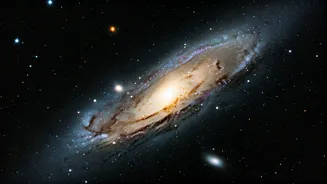
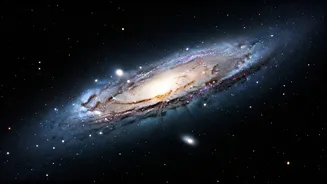
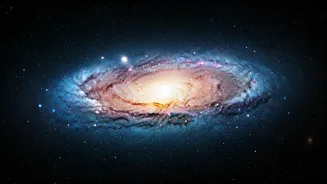
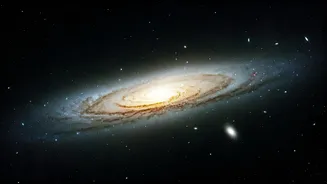
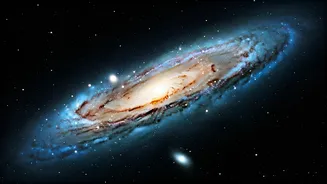
Located about 12 million light-years away in the constellation Ursa Major, Messier 82 (M82) gets its popular name from its elongated, cigar-like shape as seen from Earth. For a long time, its dusty, distorted appearance led astronomers to classify it as an irregular
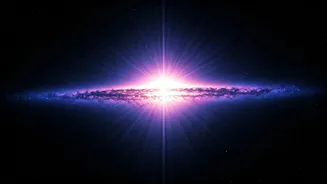
galaxy. However, more advanced observations, particularly in the near-infrared, have revealed a different story. Beneath its chaotic exterior, M82 is actually a spiral galaxy, much like our own Milky Way, but we see it from an almost perfect edge-on perspective. This unique viewing angle, combined with its other features, makes it one of the most studied objects in the night sky.
The Ultimate Starburst
The real story of M82 is its furious pace of star creation. It's the classic example of a 'starburst' galaxy, forming new stars at a rate about 10 times faster than our entire Milky Way galaxy. This intense activity is concentrated in its core, a dense and energetic environment packed with hundreds of young, massive star clusters. This frenzy isn't happening in isolation. The culprit is M82's much larger neighbor, the spiral galaxy M81. Gravitational interactions, or tidal forces, from a close encounter millions of years ago are believed to have funneled enormous amounts of gas into M82's core, triggering this massive and sustained burst of star birth.
Riding the Superwind
This frantic star formation has a dramatic consequence: a galactic 'superwind'. The combined energy from countless young, massive stars and frequent supernova explosions—about one every decade—drives a colossal outflow of gas and material from the galaxy's core. In images, this superwind appears as spectacular plumes of glowing red hydrogen gas extending thousands of light-years above and below the galaxy's disk. This isn't just cosmic exhaust; this wind is ejecting heavy elements, forged inside the galaxy's newborn stars, into intergalactic space. This process is crucial for understanding how galaxies enrich their surroundings and seed the space between them with the raw materials for future generations of stars and planets.
What Webb's Sharp Eye Reveals
While Hubble provided stunning views, much of M82's heart remained shrouded in thick dust. But the James Webb Space Telescope (JWST), with its powerful infrared vision, has pierced that veil. Recent observations from Webb, released in June 2026, have provided an unprecedentedly clear look into the galaxy's core. Astronomers were able to resolve approximately 16.5 million individual stars that were previously obscured. These new images showcase the galaxy's distended and asymmetrical disk, confirming the distorting effects of its past galactic encounter. The data also reveal a layered structure in the superwind, with ionized gas closer to the disk and small dust grains called polycyclic aromatic hydrocarbons (PAHs) further out.
A Laboratory for Cosmic History
By combining Webb's new infrared data with years of archival observations from Hubble, scientists have a complete toolkit to study this 'beautiful mess.' M82 serves as a perfect local laboratory for understanding processes that were common in the early universe, when galaxies were more compact and star formation was more intense. Studying the lifecycle of this starburst—which, in astronomical terms, is a short-lived event expected to last only a few hundred million years—helps astronomers reconstruct how galaxies evolve. The very forces driving the starburst will eventually become self-limiting, as the superwind expels the gas needed to create new stars, eventually causing the frenzy to subside.