


The Cosmic Data Traffic Jam
For as long as we have explored space, we have communicated with our probes and rovers using radio waves. This tried-and-true method has been reliable, but it has a fundamental limitation: bandwidth. As our scientific instruments become more sophisticated,
they generate massive amounts of data—high-resolution images, complex atmospheric readings, and even video. Pushing all that information through the narrow pipeline of radio frequency (RF) communication is like trying to stream a 4K movie on old dial-up internet. For example, transmitting a complete, high-resolution map of Mars using current RF technology could take as long as nine weeks. This data bottleneck slows down the pace of discovery and limits what our missions can achieve.
A Solution Written in Light
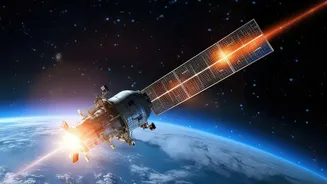
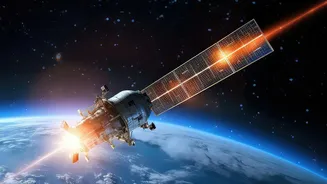
Enter optical communication, a game-changing technology that swaps radio waves for laser light. NASA's Deep Space Optical Communications (DSOC) experiment is at the forefront of this innovation. Instead of broad radio signals, DSOC uses a focused beam of near-infrared light to transmit data. Think of it as upgrading from a garden hose to a fibre-optic cable. Because light waves are much tighter than radio waves, they can carry significantly more information in a single transmission. This allows for data rates 10 to 100 times faster than the most advanced RF systems used by spacecraft today. This leap in capability means what once took weeks could now take just days, opening up a new era for deep space science.
How It Works: A Photon's Journey
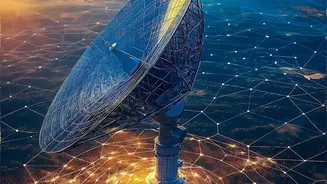
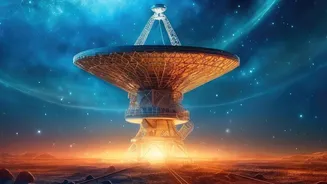
The process is both elegant and incredibly precise. It starts on a spacecraft, like NASA's Psyche mission, which carries a flight laser transceiver. This device encodes data—from engineering telemetry to high-definition video—into pulses of near-infrared laser light. The transceiver then fires this laser beam through its 8.6-inch telescope, aiming it across millions of kilometres toward Earth. On the ground, a powerful laser beacon, located at a facility like JPL's Table Mountain in California, is transmitted up to the spacecraft. This beacon acts as a guide, allowing the spacecraft's transceiver to lock on and precisely aim its data-filled downlink beam. That faint signal is collected by a massive telescope, such as the 200-inch Hale Telescope at Palomar Observatory, which uses highly sensitive superconducting detectors to 'catch' the individual photons and decode the information they carry.
Precision Pointing Across the Void
One of the greatest challenges of optical communication is the astonishing accuracy required. Hitting a detector on Earth from a spacecraft millions of kilometres away is like hitting a moving dime from a mile away. The slightest vibration on the spacecraft could throw the laser completely off target. To solve this, the DSOC transceiver is mounted on a special assembly of struts and actuators that act like a sophisticated stabilisation system. This effectively isolates the pointing mechanism from any spacecraft vibrations, ensuring the laser stays locked onto its terrestrial target. The system must also calculate the 'point-ahead' angle, accounting for the speed of light and the relative movement of both the spacecraft and Earth to ensure the photons arrive at exactly the right place.
A Flood of Data From the Final Frontier
The results of this technology have been nothing short of spectacular. In late 2023, the DSOC experiment aboard the Psyche spacecraft beamed the first ultra-high-definition video from deep space, transmitting from a distance of 19 million miles. It sent the data at a maximum rate of 267 megabits per second (Mbps)—a speed comparable to broadband internet. Even as Psyche travelled farther out, reaching 140 million miles, the system successfully transmitted data. This capability will transform future missions. Astronauts on Mars could one day stream live, high-definition video back to Earth, and probes exploring distant moons could send back massive datasets almost in real-time. This high-bandwidth connection will accelerate science and bring the experience of space exploration closer to home than ever before.