




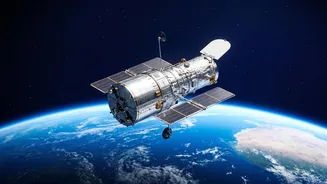
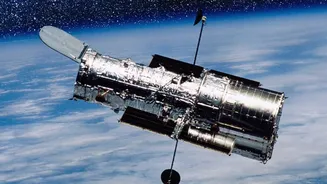
For over three decades, the Hubble Space Telescope has been humanity’s eye into the cosmos. Now, its orbit is slowly decaying, and in an unprecedented move, NASA is turning to the private sector for a potential rescue mission.
An Icon in a Slow Descent
Since its launch in 1990,
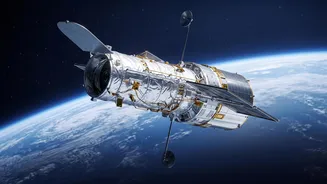
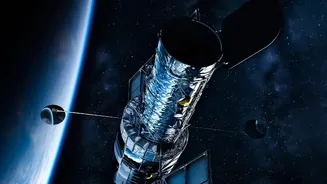
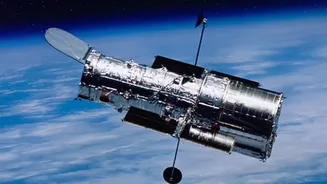
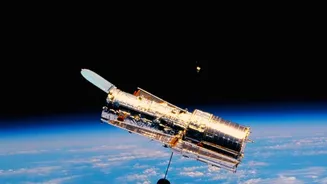
the Hubble Space Telescope has fundamentally changed our understanding of the universe, from helping to determine its age to capturing breathtaking images of distant galaxies. However, the legendary observatory faces an unavoidable threat: orbital decay. Orbiting about 540 kilometres above Earth, Hubble is still subject to faint atmospheric drag, which slowly pulls it downward. Without a propulsion system of its own to counteract this pull, the telescope's altitude is gradually decreasing. Projections estimate that if nothing is done, Hubble could make an uncontrolled reentry into Earth's atmosphere sometime in the mid-2030s. This gradual descent puts one of history's most important scientific instruments at risk of being lost forever.
NASA's Call for Commercial Solutions
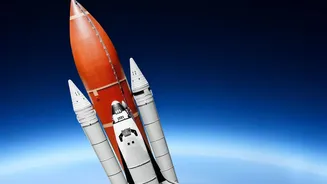
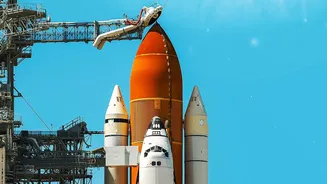
In a significant shift in strategy, NASA issued a formal Request for Information (RFI) in late October 2026, asking commercial space companies for ideas on how to address Hubble's situation. This isn't a contract, but rather a market study to see what's possible. The agency has laid out three main options: boost Hubble to a higher, more stable orbit of at least 600 kilometres; conduct a servicing mission to upgrade its systems; or, as a last resort, guide the telescope to a safe, controlled reentry and disposal. This move acknowledges the rapid evolution of the commercial space industry, which has developed capabilities for in-orbit servicing that didn't exist when the last government-led shuttle mission serviced Hubble in 2009. The deadline for responses is November 30, 2026.
The Rise of Private Space Partners
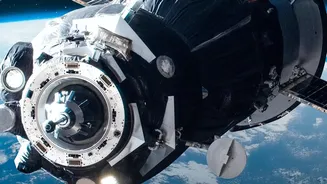
The idea of a private mission to Hubble isn't entirely new. In 2022, NASA and SpaceX signed an unfunded agreement to study the feasibility of using a Dragon spacecraft to reboost the telescope. That study was proposed in partnership with the Polaris Program, a private human spaceflight initiative funded by billionaire Jared Isaacman. While that specific plan was not pursued at the time, it opened the door for this broader inquiry. Today, the field of potential partners is growing, with companies like SpaceX, Northrop Grumman, and a host of startups developing robotic servicing vehicles and other technologies. Under the terms of the RFI, a commercial provider would be expected to supply everything from the launch vehicle and spacecraft to mission operations, with NASA providing technical expertise on Hubble.
High-Stakes, High-Reward Mission
Any attempt to rendezvous with and dock to Hubble is a high-risk endeavor. The telescope was designed to be serviced by astronauts on the Space Shuttle, not by robotic craft or modern capsules. A successful capture would require immense precision to avoid damaging the telescope's delicate optics or solar arrays. A failed attempt could even worsen Hubble's condition. However, the rewards are equally high. A successful reboost could add another 15 to 20 years to Hubble's operational life, enabling a new generation of scientific discovery. For the company that pulls it off, it would be a landmark achievement, proving the viability of a new commercial market for servicing satellites and extending the life of valuable assets in orbit. The mission would pioneer a new chapter in public–private partnerships, moving beyond cargo delivery and into complex deep–space operations.