



A Glimpse into the Cosmic Dawn
Imagine trying to make out a single candle flame from thousands of kilometres away, through thick fog. That’s the challenge astronomers face when they study the universe's first galaxies. These ancient structures are incredibly distant, and their light
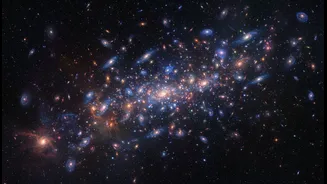
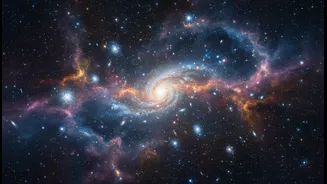
has been travelling for over 13 billion years to reach us. The period when they first ignited, known as the Cosmic Dawn, has long been a frontier of cosmology. The James Webb Space Telescope (JWST), with its unparalleled sensitivity to infrared light, was built specifically to pierce this veil, allowing us to see the universe as it was just a few hundred million years after the Big Bang.
Mature Galaxies in an Infant Universe
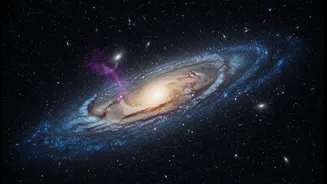
For a long time, scientists believed the first galaxies were small, simple, and chaotic collections of stars. The prevailing theory was that these proto-galaxies would slowly merge and grow over billions of years to form the large, structured galaxies we see today, like our own Milky Way. However, recent data from JWST is painting a very different picture. Astronomers from Durham University have discovered a galaxy, seen as it was over nine billion years ago, that already had a complex, star-forming 'nuclear disc' at its centre. This is a feature, common in mature galaxies, that no one expected to see so early in cosmic history. The discovery suggests galaxies were developing sophisticated internal structures much faster than models had predicted.
Cosmic Engines and Surprising Structures
The key to this early maturity appears to be a long, bar-shaped structure of stars stretching across the distant galaxy. Such stellar bars are common in modern spiral galaxies and act like cosmic conveyor belts, funnelling gas and stars toward the galactic centre. This process efficiently fuels the growth of structures like the newly discovered nuclear disc. Finding a bar-driven process happening just 4.5 billion years after the Big Bang forces a major rethink. It implies that the internal dynamics of galaxies, rather than just chaotic external mergers, have played a crucial role in their evolution from a very early stage. This challenges the long-held assumption that such organised structures only appeared much later in the universe's history.
Rewriting the First Chapter
This isn't an isolated finding. Across the board, JWST is showing that the early universe was far more developed than anticipated. Other studies have found surprisingly massive galaxies, complex mergers, and galaxies with very little rotation, all dating back to a time when they were expected to be simple and disorganized. There are even tantalizing hints of 'black hole stars' — young, growing black holes cloaked in such a dense cocoon of gas that they glow like stars — which could explain some of the impossibly bright 'little red dots' seen in deep space images. Each new discovery adds a layer of complexity, suggesting the processes that built the modern universe were already in high gear when it was just a fraction of its current age.
New Questions for a New Era
While this new data provides incredible answers, it also opens up a host of new questions. If galaxies matured so quickly, what does that mean for the first generation of stars? How did the supermassive black holes at their centres grow so large, so fast? Understanding when and how these nuclear discs form could help explain how black holes were fed during the universe's most active period. Scientists are now planning follow-up observations to study the movement of gas and stars within these ancient structures. Each dataset helps refine the computer simulations used to model the cosmos, bringing our digital universe closer to the real thing.