

The Middle-Order Conundrum
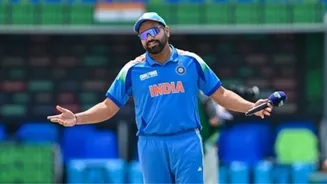
When Rohit Sharma debuted for India in 2007, he was a prodigious talent earmarked for greatness. He began his career as an off-spinner who could bat, but his coaches quickly recognised his true calling was with the willow. For years, however, he was a frustrating
puzzle for selectors and fans. Batting primarily in the middle order, his career was a string of beautiful but brief cameos. The immense talent was obvious, but consistency was elusive. From his debut until the end of 2012, he averaged just over 30 in ODIs, a figure that didn't do justice to his ability. He was even left out of India's victorious 2011 World Cup squad, a low point in his early career.
Dhoni's White-Ball Masterstroke
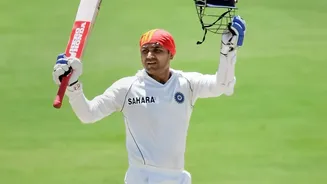
The turning point came in early 2013. With India’s long-standing opening pair of Sachin Tendulkar and Virender Sehwag moving on, there was a vacancy at the top. Captain MS Dhoni, a firm believer in Rohit's potential, saw an opportunity. As Dhoni later explained, he felt Rohit's talent was being wasted at number six, where he often didn't get enough opportunity to bat. Rohit himself has called the move a 'career-changing decision'. Dhoni approached him directly, telling him he had the qualities to succeed as an opener, particularly his command of the cut and pull shots. The first real test came in a home series against England, where an innings of 83 stamped his authority. This was solidified during the 2013 Champions Trophy in England, where he formed a formidable partnership with Shikhar Dhawan, helping India lift the trophy and cementing his new role.
Unlocking 'The Hitman'
The promotion didn't just give Rohit a new position; it unleashed a new batsman. Opening gave him the time to assess conditions and the freedom of field restrictions to play his natural, aggressive game. The elegant timer who once struggled for consistency transformed into 'The Hitman', a run-scoring machine. The records began to tumble. Later in 2013, he scored his first of three ODI double centuries, a feat no other player has achieved. This included his monumental 264 against Sri Lanka in 2014, which remains the highest individual score in ODI history. He became the top run-scorer in the 2019 World Cup, hitting a record five centuries in a single edition of the tournament. The move from the middle order to the top had turned a player of promise into a white-ball legend.
The Second Rebirth: Test Cricket
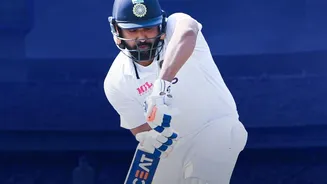
While his white-ball career soared, Rohit's Test journey remained grounded. Despite a century on debut in 2013, he struggled to cement his place in the red-ball side. His form was inconsistent, particularly in overseas conditions. By 2019, while being one of the world's best ODI players, his Test career was at a crossroads. Then, history repeated itself. Ahead of a home series against South Africa, the team management, led by then-captain Virat Kohli and coach Ravi Shastri, decided to try Rohit as a Test opener. Shastri had believed for years that Rohit's attacking style was perfectly suited to taking on the new ball. He felt Rohit got 'bored' batting lower down the order and that opening would be a 'honeymoon' for him.
Vindication in Whites
The experiment yielded immediate and spectacular results. In his very first Test as an opener against South Africa in Visakhapatnam, Rohit scored centuries in both innings, becoming the first-ever batsman to do so. He dominated the series, scoring 529 runs in four innings. Rohit has called this his 'second birth in Test cricket' and credited Kohli and Shastri for their trust in him. The move once again provided the clarity he needed. By playing his natural game and taking the attack to the bowlers, he solved India's search for a dominant Test opener and finally found the consistency that had eluded him in the longest format. He had to adapt his technique, particularly in overseas conditions like England, but the move successfully revived a career that was in danger of being unfulfilled in the Test arena.