

Sailing on Sunshine
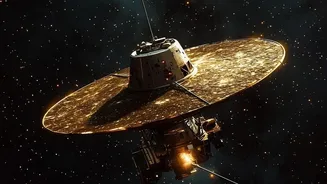
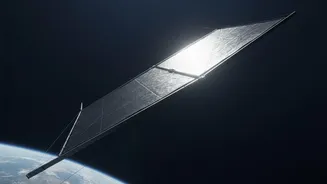
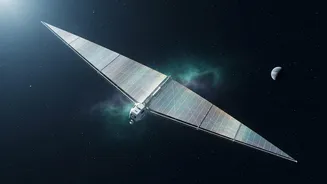
At its core, a solar sail works much like a sailboat on the ocean, but instead of wind, it uses the pressure of sunlight to move. Light is made of particles called photons which, despite having no mass, carry momentum. When these photons hit a large,
highly reflective sail, they transfer their momentum, giving the spacecraft a tiny but continuous push. In the frictionless vacuum of space, this constant, gentle acceleration adds up over time, potentially allowing a spacecraft to reach incredible speeds without a single drop of propellant. This fundamental principle gets around the biggest hurdle in rocketry, where the weight of the fuel itself dictates the limits of any mission.
From Theory to Test Flight
The idea isn't new, but turning it into a viable technology has taken decades. Early missions like Japan's IKAROS, which flew to Venus in 2010, and The Planetary Society's crowdfunded LightSail 2, which successfully changed its orbit around Earth in 2019, proved the concept works. More recently, NASA's Advanced Composite Solar Sail System (ACS3) mission represents the next significant step. Launched in 2024, ACS3 is testing new, lightweight composite booms designed to support much larger sails. The mission successfully deployed its 80-square-meter sail—about the size of a small apartment—demonstrating the viability of its advanced boom and deployment system, a crucial milestone for enabling future, more ambitious missions.
The No-Fuel Advantage
The implications of mastering solar sail technology are enormous. By eliminating the need for heavy propellant, launch costs could be drastically reduced. Spacecraft could be lighter and cheaper, opening up deep space to more players, including commercial enterprises and smaller nations. More importantly, it unlocks mission profiles that are currently impossible. Solar sails are ideal for long-duration missions, such as monitoring space weather from a fixed point between the Earth and Sun, or sending probes to survey near-Earth asteroids. Over time, the constant thrust could propel a probe to the outer edges of our solar system and beyond, making it one of the few technologies considered feasible for eventual interstellar travel.
Navigating the Cosmic Ocean
Despite the recent successes, challenges remain. The thrust from sunlight is extremely gentle, meaning acceleration is slow. Steering requires precisely angling the massive, gossamer-thin sails to catch photons at the right angle, much like tacking a sailboat. The recent ACS3 mission, while successful in its primary goal of deployment, highlighted some of these engineering hurdles, noting a slight bend in one of its new composite booms after it was pulled taut. Future advancements are looking at even larger sails—up to 2,000 square meters—and novel materials. Some researchers are also exploring concepts like 'beam sailing', where a powerful ground-based laser could be used to give a sail a much stronger push, dramatically cutting down travel times.
India's Stake in the Stars
For India's ambitious space program, this technology is particularly relevant. The Indian Space Research Organisation (ISRO) has built a global reputation for its cost-effective and innovative approach to space exploration. Solar sail technology aligns perfectly with this ethos. While ISRO is not directly involved in the ACS3 mission, the prospect of fuel-free propulsion could be a game-changer for its future deep-space ambitions, including potential follow-up missions to Mars, Venus, and beyond. As the cost of access to space continues to fall, technologies like solar sailing will be critical for nations like India to expand their scientific reach and maintain a competitive edge in the burgeoning business of space exploration.