







When winter arrives, finding the motivation to stay active can be tough. The step-up is a simple, powerful exercise perfect for an indoor routine, but safety comes first. Here’s how to master it without slips, trips, or injuries.
Why Step-Ups Are a Winter Workout Hero
The step-up is one of
the most effective and underrated exercises for your lower body. As a unilateral movement, it trains one leg at a time, which is fantastic for correcting strength imbalances between your left and right side. This functional exercise mimics everyday movements like climbing stairs, making it practical for real-life strength. It’s a compound movement, meaning it works multiple muscle groups at once, including your glutes, quadriceps, hamstrings, and even your core for stability. This efficiency is perfect for a winter fitness plan when you want maximum impact from your time spent indoors. It requires minimal equipment and space, making it an accessible choice for nearly any home workout.
The Foundation: Your Non-Slip Setup
Before you take a single step, your setup is critical. You need a stable, elevated surface. This could be a sturdy plyometric box, a low bench, or even the bottom step of a staircase. Whatever you choose, ensure it does not wobble or slide. If your floor is tile, wood, or another smooth surface, place a non-slip exercise mat underneath your step for added security. The height of your platform is also crucial. A common mistake is choosing a step that is too high. A good starting point is a height where your knee is bent at roughly a 90-degree angle when you place your foot on top. If you find yourself leaning excessively or pushing off your back foot for momentum, the step is too high.
Mastering the Basic Step-Up Form
Proper technique ensures you get the benefits without the risk of injury. Stand tall facing your platform. Place your entire right foot firmly onto the surface, not just the toes. Your foot should be flat to provide a stable base. Engage your core and keep your chest up and torso upright. Drive your weight through your right heel to lift your body up, placing your left foot beside your right on the platform. The power should come entirely from your front (right) leg. To descend, slowly lower your left foot back to the floor with control. Don't just drop down; the controlled lowering (eccentric) phase is just as important for building strength. You can either complete all repetitions on one side before switching or alternate legs.
Common Mistakes to Avoid
Many people make a few common errors that reduce the effectiveness of the step-up and increase injury risk. The biggest mistake is pushing off the back foot. This uses momentum and takes the work away from the lead leg. To fix this, try lifting the toes of your back foot slightly off the floor before you step up. Another common flaw is letting your knee cave inward. This often points to weakness in the glute muscles. Focus on keeping your knee aligned over the middle of your foot throughout the entire movement. Leaning your torso too far forward is another issue, which can strain your back and is often a sign that the step is too high or your hip mobility is limited. Finally, avoid rushing. Perform each repetition slowly and with deliberate control.
How to Progress Your Step-Ups
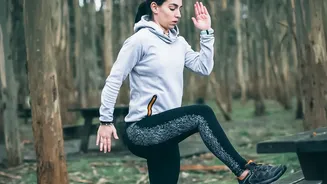
Once you've mastered the bodyweight step-up with perfect form, you can make it more challenging. The simplest way to progress is by adding weight. Hold a dumbbell in each hand or a single kettlebell at your chest in a 'goblet' position. You can also gradually increase the height of your step, but only if you can maintain proper form without compensation. Another way to increase the intensity is to add a knee drive at the top of the movement, bringing your nonworking leg up towards your chest before lowering back down. For a more explosive, athletic challenge, you can turn the movement into a stepup jump, but this advanced variation should only be attempted after you have built a strong foundation.