






What Exactly Are The Orionids?
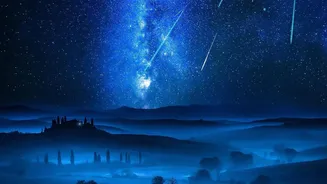
The Orionids are one of the most reliable and beautiful meteor showers of the year, active from early October to early November. They are set to peak on the nights of October 21-22, 2026. During this peak, stargazers in a dark location can expect to see
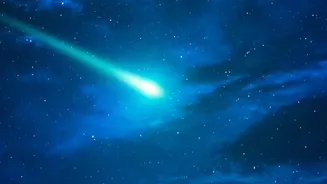
around 15 to 20 'shooting stars' per hour. These meteors are known for being particularly fast and bright, travelling at about 66 kilometres per second as they enter our atmosphere. They get their name because they appear to radiate from a point in the famous constellation of Orion the Hunter, which makes them easy to locate for sky-watchers in both the Northern and Southern hemispheres.
A Fiery Message from Halley's Comet
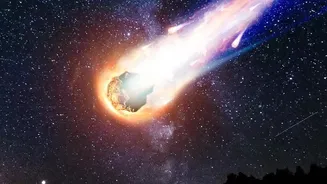
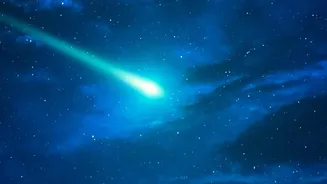
The most fascinating thing about the Orionids is their origin. Every single meteor you see is a tiny piece of the most famous comet of all: 1P/Halley, or Halley's Comet. Comets are often described as 'dirty snowballs'—vast clumps of ice, rock, and dust orbiting the Sun. As Halley's Comet travels through the solar system on its 76-year journey, the Sun's heat vaporises its surface, leaving a trail of cosmic dust and debris in its wake. The Orionid shower happens when Earth passes through this ancient trail of particles. So, while the comet itself last visited our neighbourhood in 1986 and won't be back until 2061, we get to see fragments of it burn up in our sky every October.
Comet, Meteor, or Meteorite?
These terms are often used interchangeably, but they describe different stages of the same cosmic journey. A 'comet' is the large body of ice and dust orbiting the Sun. The small bits of rock and debris it leaves behind are called 'meteoroids'. When one of these meteoroids, even one as small as a grain of sand, enters Earth’s atmosphere at high speed, it burns up due to friction. The streak of light this creates is a 'meteor'—what we call a shooting star. If any part of the object is large enough to survive the fiery descent and land on Earth's surface, it is then called a 'meteorite'. The particles that create the Orionid shower are far too small to ever reach the ground.
Earth's Annual Journey Through the Debris
The reason meteor showers are predictable annual events lies in Earth's orbit. Just as our planet follows a set path around the Sun each year, so do the debris streams left by comets. The Orionid shower occurs every October because that is when Earth’s orbital path intersects with the trail of Halley's Comet. It's like a car on a racetrack driving through a cloud of dust at the same corner on every lap. In fact, Earth crosses Halley's path twice a year, also causing the Eta Aquariid meteor shower each May. Watching the Orionids is direct evidence of our own planet's high-speed journey through the solar system.
How to Watch the Shower in India
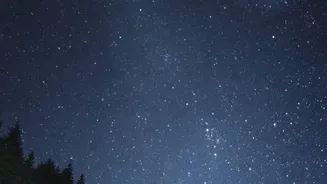
You don't need a telescope or any special equipment to enjoy the Orionids—just your eyes. The key is to find a viewing spot away from the bright lights of cities like Delhi, Mumbai, or Bengaluru. The shower will be best viewed after midnight, especially in the pre-dawn hours of October 22. This year, a bright waxing gibbous moon will interfere with the show until it sets around 3 a.m., so the best viewing window is between moonset and dawn. Find a comfortable spot, lie on a blanket, and give your eyes about 20-30 minutes to fully adjust to the darkness. Look generally towards the eastern sky to find Orion, but remember that meteors can appear anywhere and will often have the longest, most dramatic trails far from their radiant point.