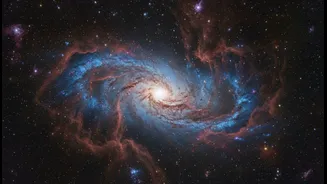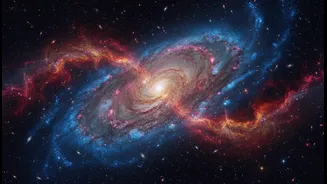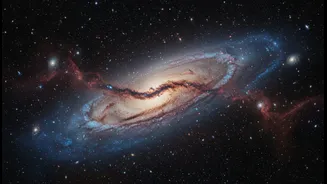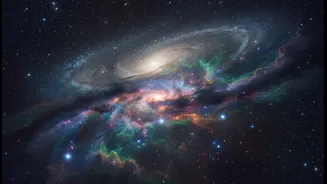





A Glimpse into the Frenzy
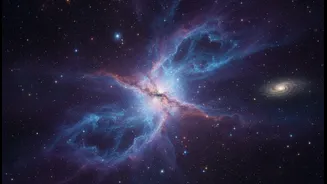
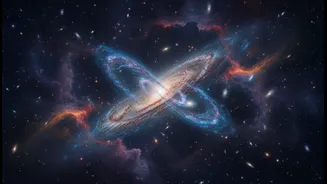
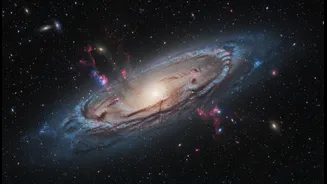
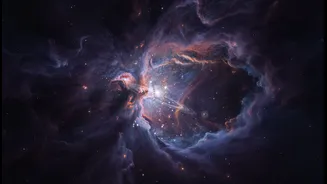
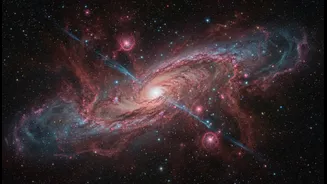
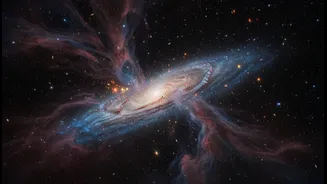
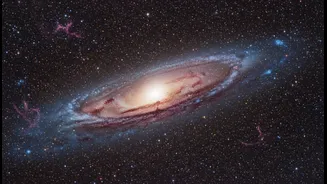
The focus of this new fascination is a 'starburst' galaxy, a place where stars are being born at a furious pace. While our own Milky Way galaxy calmly produces about three sun-sized stars per year, these cosmic building sites can churn out stars at rates
ten, or even hundreds of times higher. This intense activity makes them incredibly bright. The featured subject is often a galaxy like Messier 82 (M82), also known as the Cigar Galaxy, a classic example of a starburst galaxy located about 12 million light-years away. Its recent observations by the JWST provide an unprecedented look into the conditions that fuel such rapid creation. For comparison, M82 forms new stars ten times faster than our own galaxy does.
Why It's a 'Building Site'
The term 'building site' is an apt metaphor for the extreme environment inside a starburst galaxy. These are regions packed with enormous quantities of gas and dust—the raw materials for star formation. Often, this frenzy is triggered by a galactic-scale event, such as a close encounter or a direct collision with another galaxy. These interactions send gravitational shockwaves through the galaxies, causing vast clouds of gas to collapse and ignite into hundreds of new stars almost simultaneously. In the case of M82, its hyperactivity is thought to have been triggered millions of years ago by a gravitational interaction with its larger neighbor, M81. This cosmic dance sent gas pouring into M82's core, providing the fuel for its current stellar baby boom.
What Webb's Infrared Eyes Reveal
Previous telescopes, like the Hubble Space Telescope, have observed these galaxies, but much of the action was hidden behind thick veils of cosmic dust. This is where the James Webb Space Telescope's power shines. Webb is designed to see the universe in infrared light, which can penetrate these dense dust clouds that obscure visible light. This allows astronomers to peer directly into the heart of the starburst. In recent images of M82, Webb’s NIRCam (Near-Infrared Camera) has revealed stunning new details, including the fine structure of a galactic 'superwind'—an outflow of material driven by the intense star formation and supernova explosions at the core. These outflows are depicted as red filaments, tracing the path of chemical molecules that highlight the wind's structure in a way never seen before.
The Science of Star Birth
Beyond the beautiful imagery, these observations provide crucial data. By looking closer at the galaxy's core, Webb has identified concentrated areas of iron, shown as green specks, which are mostly remnants of past supernova explosions. It also shows regions where molecular hydrogen is being illuminated by the radiation from young, hot stars. Another galaxy studied by Webb, NGC 7469, showcases a starburst ring in incredibly close proximity to an active supermassive black hole. For a long time, the dust and compact nature of this region made it hard to study. Webb's clarity allows scientists to investigate the complex relationship between a galaxy's central black hole and its star-forming activity, revealing how the black hole's energy output can both trigger and suppress the birth of stars.
A Window to the Cosmic Past
Studying these nearby building sites offers more than just a snapshot of a dramatic process; it provides a window into the distant past. Starburst galaxies were much more common billions of years ago when the universe was smaller and galaxies were closer together, leading to more frequent collisions. By studying galaxies like M82 and NGC 7469, astronomers can essentially study a local analogue for the types of galaxies that existed in the early universe. This helps us piece together our own cosmic origin story, understanding how the first stars formed and eventually assembled into the massive, structured galaxies, like our own Milky Way, that we see today.