




When we look at the night sky, we see countless points of light. But not all stars are created equal. The main difference between a 'red giant' and an 'ordinary' star isn't what they are, but when they are in their cosmic life story.
The 'Ordinary' Star: A Main-Sequence Marvel
Most stars, including
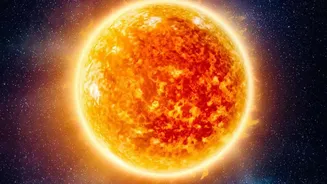
our own Sun, are classified as 'main-sequence' stars. This is the long and stable adulthood of a star's life, a phase that can last for billions of years. During this time, the star is in a state of perfect balance, known as hydrostatic equilibrium. The immense inward pull of gravity is perfectly counteracted by the outward pressure from the nuclear fusion happening in its core. In this stellar furnace, hydrogen atoms are fused together to create helium, releasing a tremendous amount of energy in the process. This energy is what makes the star shine. The star's size, temperature, and colour are all determined by its mass during this phase.
The Beginning of the End: Running on Fumes
The main-sequence stage, however, cannot last forever. A star's life is a constant battle against gravity, and that battle requires fuel. The defining moment in a star's evolution towards becoming a red giant is when it exhausts the hydrogen fuel in its core. With the hydrogen fusion engine sputtering out, the outward pressure weakens, and gravity begins to win. The core starts to contract and heat up under its own weight. This is the trigger for the dramatic transformation that follows, marking the end of the star's stable adult life and the beginning of its senior years.
The Red Giant Phase: Bigger, Brighter, and Cooler
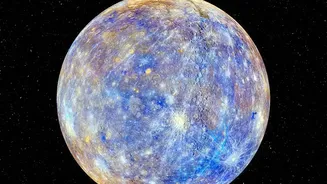
The collapsing core becomes intensely hot. This heat ignites a shell of hydrogen that surrounds the now-inert helium core, causing it to begin fusion. This new, furious energy production pushes the star's outer layers dramatically outwards. The star swells to an enormous size, becoming hundreds of times larger than its original form. If our Sun were to become a red giant, it would likely expand enough to engulf Mercury, Venus, and possibly even Earth. Paradoxically, as the star's surface expands so far from its energy source, its surface temperature drops, causing it to glow with a reddish-orange hue. So, a red giant is simultaneously more luminous (brighter) overall because of its massive size, but has a cooler surface than it did as a main-sequence star.
A New Kind of Fire: Fusing Helium
The changes don't stop there. As the core continues to contract and heat up, it can eventually reach the staggering temperatures needed to begin fusing helium into carbon. For a star like our Sun, this ignition is a rapid and explosive event known as the 'helium flash'. The star now has two energy sources: helium fusion in the core and hydrogen fusion in the shell around it. This new phase brings a temporary stability, but the star is now on a much faster track. Once the helium is gone, low-mass stars like the Sun don't have enough mass to fuse heavier elements, and the end is near.
The Final Act: A Planetary Nebula and White Dwarf
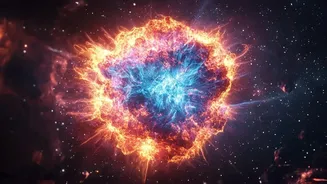
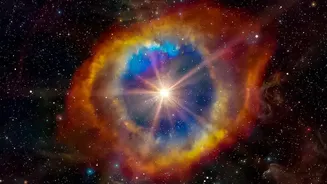
After exhausting its core helium, a star like our Sun will become unstable. It will enter a final phase of expansion, shedding its outer layers into space in great, billowing clouds of gas and dust. This beautiful, glowing structure is known as a planetary nebula. Left behind at the center is the star's collapsed, incredibly dense core: a white dwarf. This Earth-sized remnant, no longer producing energy through fusion, will simply cool and fade over billions of years, a stellar ghost of its former self. More massive stars have a more dramatic end, exploding in a supernova.