



The Old Way: The Burden of Chemical Fuel
Traditionally, satellites have relied on chemical propulsion to get into their final orbit and stay there. This involves igniting a propellant and an oxidiser, creating a powerful but brief burst of thrust. Think of it like the engine of a race car: immense
power, but it burns through fuel at a tremendous rate. For satellites, especially large communication satellites heading to geostationary orbit, this has meant carrying massive amounts of chemical fuel. In many cases, the propellant can account for more than half of the satellite's total launch mass. This not only makes the satellite heavy and expensive to launch but also limits the amount of room available for the actual money-making or science-gathering equipment, known as the payload.
A Gentle Push: What Is Electric Propulsion?
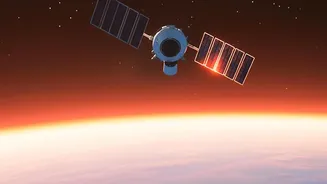
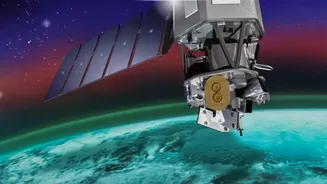
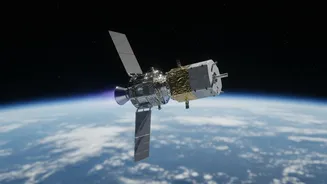
Electric propulsion works on a completely different principle. Instead of a violent chemical reaction, it uses electrical power, typically generated by the satellite's solar panels, to accelerate a small amount of inert gas propellant, like xenon. This creates a very gentle but continuous thrust. If chemical propulsion is a sprint, electric propulsion is a marathon. An ion thruster, a common type of electric propulsion, uses electric fields to ionize (give an electrical charge to) xenon atoms and then accelerate them to extremely high speeds, ejecting them to push the satellite forward. The thrust at any given moment might be tiny—sometimes compared to the force of a sheet of paper resting on your hand—but because it can be sustained for weeks, months, or even years, it can produce significant changes in velocity over time.
The Weight-Loss Advantage
The primary advantage of electric propulsion is its incredible efficiency. It has a much higher specific impulse, which is the measure of how much push you get from a certain amount of fuel. Electric thrusters can be five to ten times more efficient than their chemical counterparts. This means a satellite needs to carry far less propellant to perform its mission. For example, a communication satellite that might have needed over 2,000 kg of chemical fuel can achieve the same results with just a few hundred kilograms of xenon. This drastic weight reduction has a cascading effect. A lighter satellite can be launched on a smaller, cheaper rocket. Alternatively, the weight saved on fuel can be dedicated to more transponders on a communication satellite or more advanced scientific instruments, enhancing the mission's capability and potential revenue.
Going the Distance: A Longer Operational Life
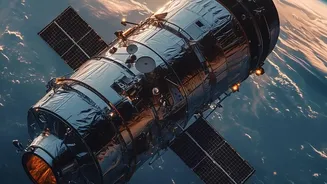
A satellite's life isn't determined by its electronics failing, but by when it runs out of the fuel needed for "station-keeping." Satellites in geostationary orbit need to make constant, tiny adjustments to their position to counteract gravitational pulls and stay in their designated spot. With the hyper-efficient use of propellant by electric thrusters, this station-keeping can be performed for a much longer time. A satellite that was designed for a 12-to-15-year lifespan with chemical fuel could potentially operate for 20 years or more using electric propulsion. This extended operational life is a massive economic boon, allowing a single satellite to generate revenue or collect data for many more years before a replacement is needed.
ISRO's Electric Ambitions
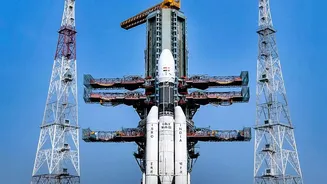
ISRO has been actively developing and integrating this technology to enhance its competitive edge in the global space market. While it has used imported electric thrusters in the past, such as on the GSAT-9 satellite, the agency is now focused on deploying its own indigenously developed systems. A key milestone is the Technology Demonstrator Satellite (TDS-01), designed to validate a fully Indian-made electric propulsion system. ISRO has conducted extensive ground tests on its thrusters, proving their reliability for long-duration missions. By mastering this technology, ISRO can build more powerful communication satellites with greater transponder capacity and undertake more ambitious deep-space missions, reducing reliance on foreign components and solidifying its position as a self-reliant space power.