



Meet the 'Ghost Particles'
Neutrinos are fundamental particles, but they are unlike the familiar protons and electrons that make up the atoms in our bodies. They have almost no mass and no electric charge, which allows them to travel for billions of light-years in a straight line,
passing through planets, stars, and entire galaxies as if they were empty space. Because they travel unimpeded, they are pristine messengers from the most violent and energetic events in the universe, carrying secrets from the hearts of cosmic accelerators that are otherwise hidden from our telescopes. Detecting them, however, is incredibly difficult. Scientists have built colossal detectors, like the IceCube Neutrino Observatory buried deep in the Antarctic ice, to catch the faint flashes of light produced on the rare occasion a neutrino interacts with matter.
The Case of the 'Shadow Blaster'
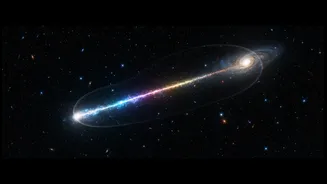
One of the most exciting recent developments in neutrino astronomy involves a distant galaxy nicknamed the 'Shadow Blaster'. In 2021, the IceCube observatory detected a single, extremely high-energy neutrino. Astronomers traced its path back to a galaxy 11 billion light-years away. This galaxy, officially named JCMT0402−0424, earned its nickname because it is shrouded in so much dust that it's nearly invisible to traditional telescopes, yet it is furiously giving birth to new stars. Previously, the only confirmed extragalactic neutrino sources were blazars—galaxies with supermassive black holes shooting out jets of matter. The Shadow Blaster suggests a new type of source: intense star-forming regions. However, linking a single particle to a single source across billions of light-years is a game of probabilities. It's a strong candidate, but the possibility that the alignment is a coincidence remains.
A Glow from Our Own Galaxy
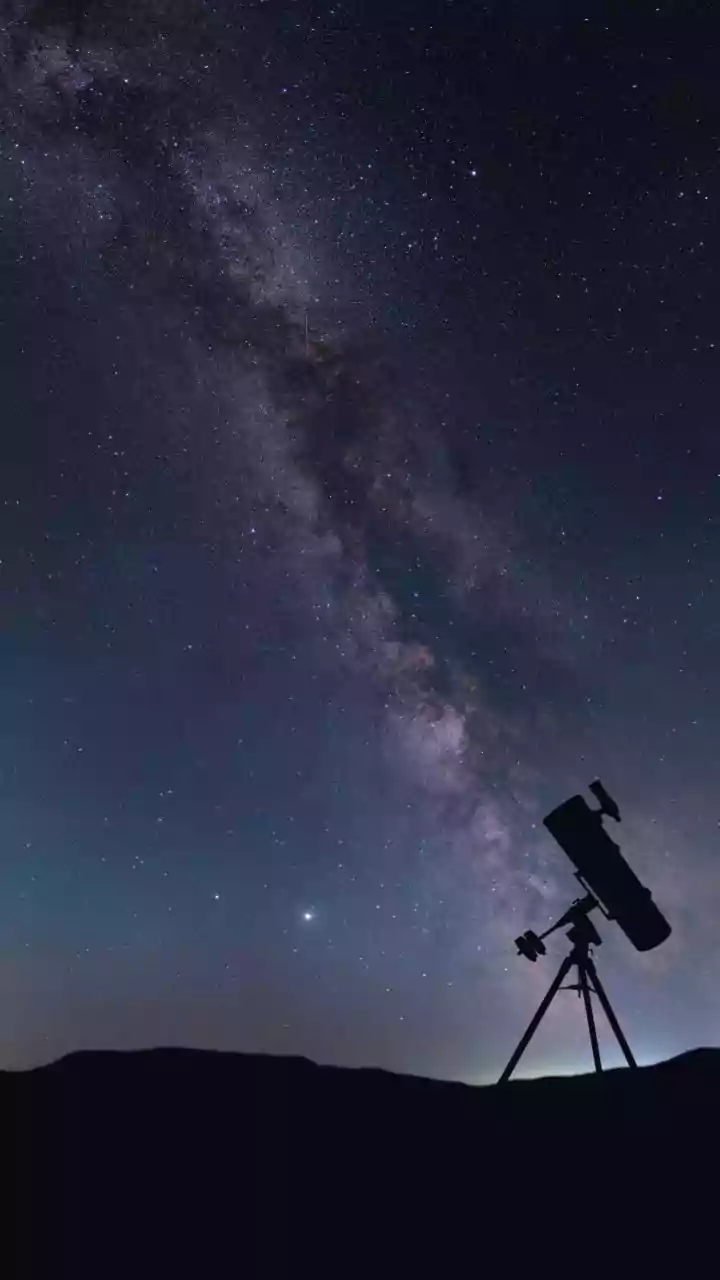
While the Shadow Blaster points to a distant galaxy, an even more profound discovery brings the mystery closer to home. For the first time, scientists have found strong evidence that our own Milky Way galaxy is a source of high-energy neutrinos. This wasn't a single flash from a specific point, but a diffuse glow detected across the galactic plane—the dense, star-filled band of our galaxy we see in the night sky. Using 10 years of data from IceCube, involving 60,000 detected neutrinos, researchers used machine learning to distinguish the signal from the background noise of particles hitting Earth's atmosphere. The result was a 'neutrino map' of the Milky Way, confirming a long-held theory that the same processes creating gamma rays in our galaxy should also produce neutrinos.
Plausible, Not Proven: The Key Limit
This is where the headline's crucial caveat—'not an absolute certainty'—comes into play. In particle astrophysics, discoveries are measured in 'sigma,' a statistical term for confidence. The detection of neutrinos from the Milky Way's plane came with a significance of 4.5 sigma. This indicates a high degree of confidence and is considered strong evidence, but it is not yet the 'gold standard' of 5 sigma that typically signifies a definitive discovery. Furthermore, this detection is of a diffuse emission. Scientists know the neutrinos are coming from the general direction of the galactic plane, but they haven't yet identified the specific sources—the individual supernova remnants or star-forming regions—that are creating them. Identifying these individual galactic 'neutrino factories' is the next major challenge for astronomers.