






A World of Surprises
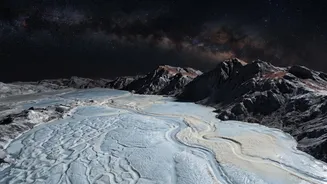
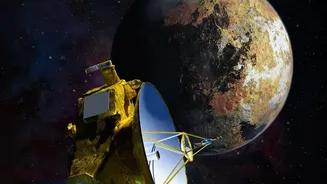
When NASA’s New Horizons spacecraft flew past Pluto in 2015, it completely upended our understanding of the dwarf planet. Instead of a cold, dead, and heavily cratered world, the probe revealed vast plains of nitrogen ice, towering mountains of water
ice, and a surprisingly young surface with very few craters in some areas. This lack of impact craters, particularly in the famous heart-shaped region known as Sputnik Planitia, was a clear sign that the surface was being renewed over time. This suggested that geological processes have been active in Pluto's relatively recent past. Scientists were stunned to find a world far more complex and active than they had ever imagined.
The Tell-Tale Heart
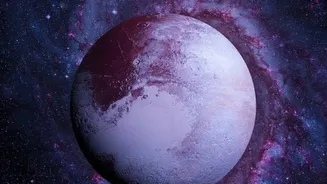
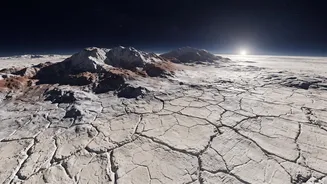
Much of Pluto's activity appears centered around Sputnik Planitia, the western lobe of its iconic heart. This enormous basin is filled with nitrogen, methane, and carbon monoxide ices. The surface is divided into large, polygon-shaped cells that are believed to be churning slowly, like a giant lava lamp. This convection is driven by the faint heat rising from Pluto’s interior, which is enough to stir the volatile ices. This process constantly renews the surface, erasing craters and keeping it looking young. But the activity isn't just a slow churn. Researchers have also identified features that look like cryovolcanoes—ice volcanoes that spew a slushy mix of water and other substances instead of molten rock. The existence of these massive mounds, some several kilometers high, suggests Pluto has had more internal heat for longer than previously thought possible.
New Evidence of Liquid Flow
The most compelling new evidence for ongoing activity comes from a study released in August 2026. By re-analyzing high-resolution images from New Horizons, scientists found dark streaks on the northern edge of Sputnik Planitia that strongly resemble features on Earth’s glaciers where liquid water has wetted the surface. Since it’s far too cold for liquid water on Pluto’s surface, and nitrogen rain is physically impossible under its thin atmosphere, researchers concluded the liquid must be coming from below. The leading theory is that liquid nitrogen, melted deep beneath the ice by Pluto's internal heat and pressure, is rising through cracks and briefly flowing on the surface before freezing again. This is the first evidence of recently flowing liquid ever documented on the dwarf planet.
The Engine Under the Ice
So, what is powering all this activity billions of years after Pluto’s formation? The answer likely lies in a combination of factors. The initial energy comes from the decay of radioactive elements within Pluto's rocky core, a process that has been generating heat since the solar system was young. Many scientists also believe that Pluto harbors a vast subsurface ocean of liquid water, insulated by its thick ice shell. The gradual freezing of this ocean over billions of years could create stress and fractures in the overlying ice crust, providing pathways for materials to move. While the existence of this ocean hasn't been directly confirmed, the weight of a dense liquid ocean beneath Sputnik Planitia would explain why the feature is located where it is relative to Pluto's moon, Charon. This hidden ocean, combined with residual heat, could be the engine driving the cryovolcanism and liquid nitrogen flows we are now seeing signs of.
Rethinking Icy Worlds
The discovery that Pluto is, or very recently was, geologically active forces a major rethink of how small, icy worlds evolve. It was once assumed that such small bodies would have lost all their formation heat long ago, rendering them geologically inert. But Pluto proves that even in the frigid outer reaches of the solar system, worlds can retain enough internal heat to power complex geology, including flowing liquids and volcanism. This has profound implications, suggesting that other large objects in the Kuiper Belt, like Eris and Makemake, could also be hiding surprisingly dynamic interiors beneath their frozen surfaces. Pluto has transformed from a simple point of light in our telescopes to a complex and active world that continues to challenge our understanding of planetary science.