

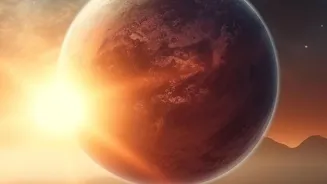
Our Cosmic Neighbors: The TRAPPIST-1 System
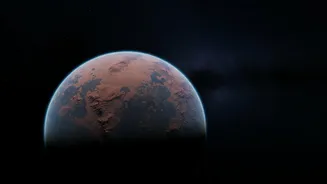
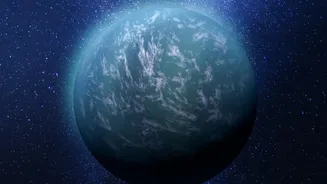
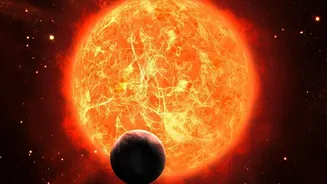
Just 40 light-years away lies one of the most fascinating planetary systems ever discovered: TRAPPIST-1. It’s a miniature version of our own solar system, with at least seven rocky, Earth-sized planets orbiting a small, cool star called an ultracool red dwarf.
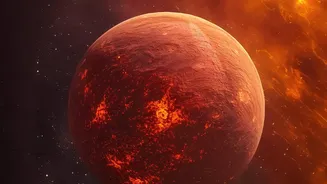
What makes this system particularly exciting is that three of its planets—named TRAPPIST-1e, f, and g—orbit within the star's 'habitable zone'. This is the 'Goldilocks' region where conditions might be just right for liquid water to exist on a planet's surface, a crucial ingredient for life as we know it. The planets are so close to their star that their 'years' are incredibly short; TRAPPIST-1e, for example, completes an orbit in just six Earth days. Because of their proximity to us and this tantalizing setup, these worlds have become a prime target for astronomers searching for signs of life.
Listening to an Alien Sky
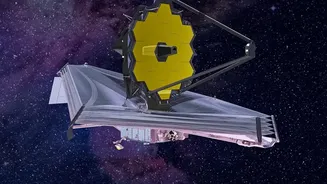
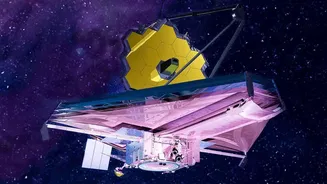
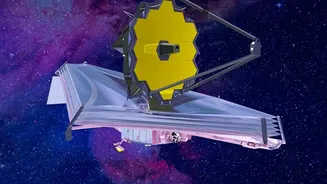
How can we study planets that are light-years away? Scientists use a technique called transit spectroscopy. When an exoplanet passes in front of its star from our point of view, a tiny fraction of the starlight shines through the planet's atmosphere, if it has one. Powerful instruments, like those on the James Webb Space Telescope (JWST), can analyze this light and look for the chemical fingerprints of different gases. Each gas absorbs light at specific wavelengths, creating a unique barcode-like pattern that reveals the atmosphere's composition. Using this method, scientists have begun to probe the skies of the TRAPPIST-1 planets, ruling out thick, hydrogen-heavy atmospheres for some and getting tantalizing hints about others. It's like cosmic detective work, where every sliver of light carries a potential clue.
The Carbon Clue: Why 'Heavy' Matters
Carbon is the backbone of all known life, so finding it in an exoplanet's atmosphere, perhaps as carbon dioxide (CO2), is interesting but not proof of life. After all, volcanoes and other geological processes can produce CO2. But scientists are looking for a more specific clue hidden within the carbon itself. Carbon atoms come in different forms, or isotopes, the most common being carbon-12 (C-12) and the slightly heavier carbon-13 (C-13). Here on Earth, life shows a distinct preference. Photosynthetic organisms like plants and algae find it easier to absorb the lighter C-12 from the atmosphere. This means that over vast timescales, biological processes actively pull C-12 out of the air, leaving behind a higher relative concentration of the heavier C-13. An atmosphere that is unusually rich in 'heavy' carbon could therefore be a sign that a biosphere is at work.
A 'Smoking Gun' for a Biosphere?
If the James Webb Space Telescope were to detect an atmosphere on a planet like TRAPPIST-1e that is not only rich in carbon dioxide but has a suspiciously high ratio of heavy C-13 to light C-12, it would be a groundbreaking discovery. This 'isotopic disequilibrium' is considered a potential biosignature because it's hard to explain without a widespread biological process constantly filtering the carbon. It would suggest that something on the planet is consuming the lighter carbon, much like the vast forests and oceans of phytoplankton do on Earth. It wouldn't be a picture of an alien creature, but it would be a powerful, indirect piece of evidence pointing towards a living, breathing world—a planetary-scale sign of a functioning biosphere.
Not So Fast: Ruling Out the Imposters
As exciting as this sounds, science demands caution. A heavy carbon signature is not a guaranteed sign of life. Researchers must first rule out all possible non-biological, or 'abiotic,' explanations. For instance, a planet's atmosphere could gradually lose its lighter gases to space over millions of years, leaving the heavier ones behind. Certain types of geological or photochemical reactions, not yet fully understood, might also mimic this biological signature. This is why context is key. Scientists would look for other clues, such as the presence of methane and the absence of carbon monoxide, which together can strengthen the case for biology. Detecting a potential biosignature is only the first step; the much harder part is proving it could not have been created any other way.