

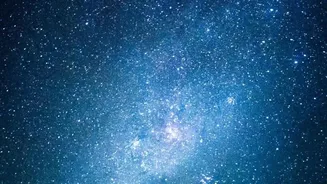
The Year's Best Meteor Shower: The Perseids
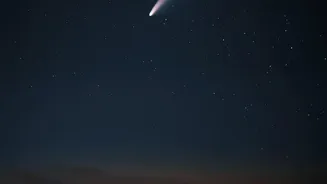
The absolute highlight of August is the Perseid meteor shower, considered one of the best of the year. This shower is active from mid-July to late August, but it will reach its peak in India on the night of August 12 and into the pre-dawn hours of August 13.
This year's peak is special because it coincides with a new moon, meaning the sky will be exceptionally dark, making it possible to see even fainter meteors. Under ideal conditions, far from city lights, you could see 50 to 100 meteors per hour. These meteors are pieces of debris from Comet Swift-Tuttle, and they burn up in our atmosphere, creating the beautiful streaks of light we call shooting stars. For the best view, find a dark spot after midnight, lie back, and give your eyes about 20-30 minutes to adjust to the darkness. No special equipment is needed; the show is best enjoyed with the naked eye.
A Parade of Planets Before Dawn
August 2026 offers a rare chance to see a 'planet parade'. Around August 12, six planets—Jupiter, Mercury, Mars, Saturn, Uranus, and Neptune—will appear in an alignment across the pre-dawn sky. For observers in India, the best time to look is in the hour or two before sunrise. You'll need a clear view toward the eastern horizon. Not all planets will be equally easy to spot. Mars, with its distinct reddish glow, and Saturn, with a steady yellowish tint, will be the brightest and easiest to see with the naked eye. Jupiter and Mercury will be much lower towards the horizon and might be challenging to see in the morning twilight. Uranus and Neptune are too faint for the naked eye, but can be spotted with a good pair of binoculars or a small telescope.
Saturn and Mars Take Centre Stage
While several planets are visible, Saturn and Mars are putting on a particularly good show this month. Saturn will be visible for much of the night, rising in the east around 10:30 PM IST and tracking across the sky. It is retrograding, or appearing to move backward, in the constellation Pisces. Mars rises a few hours later, around 2:00-2:30 AM IST, and will be visible in the eastern sky before dawn, marching through the constellation Gemini. You can easily tell planets from stars because planets tend to shine with a steady light, while stars twinkle. Both Mars and Saturn are bright enough to be easily seen from most locations, even with some light pollution.
The Summer Triangle and the Milky Way
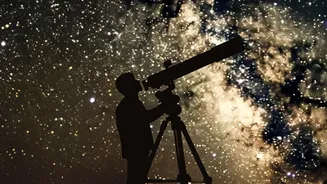
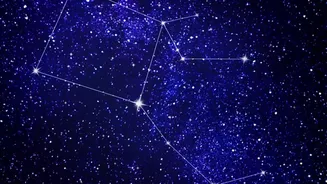
August is a fantastic month for constellation hunters. Look almost directly overhead for the 'Summer Triangle', a prominent pattern formed by three of the brightest stars in the night sky: Vega, Deneb, and Altair. Vega is the brightest of the three, part of the constellation Lyra, the Harp. Deneb is in Cygnus, the Swan, and Altair is the brightest star in Aquila, the Eagle. If you are in a location with very dark skies, free from city lights, you will see a faint, hazy band of light stretching through the Summer Triangle. This is the Milky Way, our home galaxy. The view is particularly spectacular in August as we look towards the galaxy's dense centre, located in the direction of the constellation Sagittarius, which appears like a teapot low in the southern sky.
Tips for Monsoon Skywatching
Stargazing in India during August can be challenging due to the monsoon. However, it's not impossible. The key is to be flexible and take advantage of any breaks in the cloud cover. Check the weather forecast frequently for clear windows, which often occur late at night or in the early morning hours. Even an hour of clear sky is enough to catch the Perseid meteor shower or spot a bright planet. If you live in a city, try to get to a rooftop or a park to escape the worst of the direct street lighting. Let your eyes fully adapt to the dark for about 20-30 minutes and avoid looking at your bright phone screen; if you must use a light, a red torch is best as it preserves your night vision.