





Beyond the Six-Pack: What Is Functional Core Strength?
For years, the image of core strength has been the coveted six-pack. But true core strength isn't just about what you see in the mirror. Functional core strength refers to the integrated stability and power of your entire torso—from your shoulders down
to your hips. This includes your abs, obliques, lower back, and glutes working together as a single, powerful unit. Think of it as your body's central pillar. A strong functional core doesn't just look good; it helps you perform everyday activities with ease and safety, like lifting a heavy gas cylinder, playing with your children, or simply maintaining good posture while working at a desk for hours. It’s the foundation for all movement, protecting your spine and transferring force efficiently through your body.
Why Crawling Is a Core Superpower
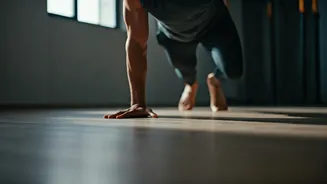
Before we could walk, we crawled. This primal movement pattern is hardwired into our brains and bodies, and returning to it as a form of exercise offers incredible benefits. When you crawl, you engage in a contralateral movement (opposite arm and leg move together), which is fundamental to human locomotion like walking and running. This forces your core to work overtime to prevent your torso from rotating. Unlike an isolation exercise like a crunch, crawling integrates the upper body, lower body, and core into one fluid motion. It builds shoulder stability, hip mobility, and full-body coordination. The 'weightless' aspect simply means you're using your own body weight as resistance, making it an accessible, effective workout you can do anywhere, anytime.
Start with the Bear Crawl
The Bear Crawl is the cornerstone of all crawling exercises. It’s simple to learn but challenging to master, making it perfect for beginners and seasoned athletes alike. How to do it: 1. Start on all fours, with your hands directly under your shoulders and your knees directly under your hips. Your back should be flat, like a tabletop. 2. Engage your core and lift your knees just an inch or two off the ground. This is your starting position. Your weight should be on your hands and the balls of your feet. 3. Begin crawling forward by moving your right hand and left foot forward simultaneously, just a few inches. Keep your hips low and stable—avoid letting them sway from side to side. 4. Follow by moving your left hand and right foot forward. 5. Continue this pattern, taking small, controlled steps. Aim to keep your back flat and your knees close to the ground. Try crawling forward for 10 metres, and then backward to return.
Flip It Over: The Crab Walk
The Crab Walk challenges your body in a completely different plane of motion, targeting the posterior chain—your glutes, hamstrings, and lower back—while also working your shoulders and triceps. How to do it: 1. Sit on the floor with your knees bent and your feet flat on the ground, about hip-width apart. 2. Place your hands on the floor behind you, with your fingers pointing towards your hips. 3. Lift your hips off the ground until your body forms a straight line from your knees to your shoulders. This is the 'tabletop' position. Squeeze your glutes to keep your hips elevated. 4. Begin 'walking' backward by moving your right hand and left foot, then your left hand and right foot. 5. Focus on keeping your hips high and not letting them sag. This exercise is fantastic for improving posture and strengthening the often-neglected muscles on the back of your body.
Progress to the Leopard Crawl
Once you're comfortable with the Bear Crawl, you can try the Leopard Crawl. It’s a more dynamic, fluid movement that requires greater coordination and core control. It’s lower to the ground and covers more distance with each step. How to do it: 1. Start in the same all-fours position as the Bear Crawl, but place your hands and feet slightly wider apart. 2. As you prepare to move, lower your entire body closer to the ground. Your movements should be longer and more deliberate than the Bear Crawl. 3. Move your right hand and left foot forward in a long, reaching motion, allowing your hips to sink slightly as you move. 4. Your body should feel like it's gliding just above the floor. The key is to keep the movement smooth and controlled, not jerky. 5. This variation increases the time under tension for your core and shoulders, providing a more intense workout.
Putting It All Into a Routine
Incorporating these exercises into your fitness regimen is easy. You don't need a full hour; even 10-15 minutes can make a difference. A simple starting routine: - Bear Crawl: 30 seconds forward, 30 seconds backward. - Rest: 30 seconds. - Crab Walk: 30 seconds forward/backward. - Rest: 30 seconds. - Repeat this circuit 3-4 times. Focus on quality over quantity. It's better to move slowly with perfect form than to rush with a swaying back and sagging hips. Keep your core tight and breathe steadily throughout the movements. As you get stronger, you can increase the duration or add more advanced variations.