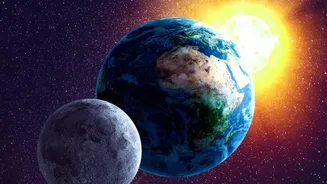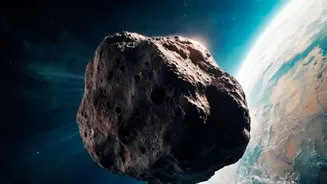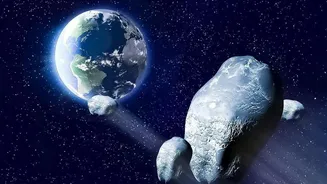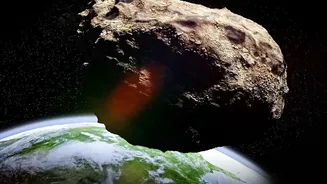



Look up. Our Moon isn't as lonely as you think. Earth has a new, temporary companion: a tiny asteroid named 2026 QQ8, now caught in our planet's gravity. This 'mini-moon' offers a rare glimpse into a dynamic cosmic dance.
What Exactly Is a 'Mini-Moon'?
The term 'mini-moon' might sound
like something from a movie, but it's a real astronomical phenomenon. These aren't true moons like our familiar, permanent satellite. Instead, they are small asteroids or space rocks that get temporarily snared by Earth's gravitational pull. Think of it less like a marriage and more like a brief orbital fling. While our main Moon is locked in a stable, predictable orbit, mini-moons follow chaotic, looping paths for a few months or years before the Sun's gravity inevitably yanks them away, sending them back on their journey through the solar system.
Meet Our New Visitor: Asteroid 2026 QQ8
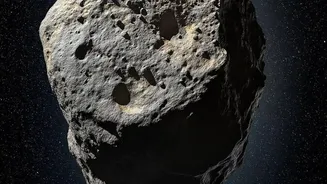
The latest celestial visitor is 2026 QQ8. Discovered in August 2026 by Hungarian astronomer Krisztián Sárneczky, this object initially puzzled scientists. Was it a natural asteroid or just a piece of old space junk, like a spent rocket booster? After careful observation with powerful telescopes in Arizona and Hawaii, it was confirmed to be a natural space rock. It's incredibly small, measuring only about two metres (or six feet) across — roughly the size of a car. Orbital calculations then revealed the bigger picture: this tiny asteroid had been quietly captured by Earth's gravity back in April 2026.
The Delicate Science of a Capture
Capturing an asteroid is a delicate cosmic ballet. For an object like 2026 QQ8 to become a mini-moon, it needs to approach Earth at just the right speed and angle. It enters a region known as the Hill sphere, where Earth's gravity is dominant over the Sun's. However, the Sun and our own Moon still exert powerful gravitational tugs. This complex three-body interaction slows the asteroid down just enough for it to fall into a temporary, wobbly orbit instead of flying past. The orbit of 2026 QQ8 is far from a perfect circle; it's a chaotic, looping path that will keep it as our companion for several months.
A Rare Window for Science
For scientists, a temporarily captured object like 2026 QQ8 is a golden opportunity. It's essentially a free sample of an asteroid delivered right to our doorstep, without the immense cost of launching a deep-space mission to retrieve one. Studying these mini-moons allows researchers to refine their models of the gravitational environment around Earth, which is crucial for tracking all near-Earth objects. It also provides a low-velocity target to test technologies for future missions, including those related to planetary defense or even asteroid mining. By analysing the light reflected from 2026 QQ8, scientists can learn about its composition, providing clues about the building blocks of our solar system.
Can I See It and Will It Stay?
Before you rush out with your binoculars, know that 2026 QQ8 is far too small and faint to be seen with anything less than a large, professional observatory telescope. It poses zero threat to Earth, with its closest approach still about 1.5 times farther away than our permanent Moon. Its stay is also fleeting. By early December 2026, the gravitational dance will shift. The Sun's overwhelming pull will win out, and 2026 QQ8 will be flung out of Earth's orbit, resuming its own independent journey around the Sun. It has an orbit very similar to Earth's, taking about 359 days to circle the Sun, and will likely pass by our planet again in about a decade, though another capture isn't guaranteed.