





A Discovery Heard Across the Himalayas
The news was the kind that captures the public imagination: Pranim Limbu, a young citizen scientist from a remote village in West Sikkim, made a significant astronomical discovery. While participating in the Rad@home project, an India-based citizen science
initiative, Limbu identified a rare and unusually shaped radio galaxy, an asymmetrical structure that automated systems might have missed. This was not the work of a professional astronomer in a high-tech observatory, but a volunteer sifting through data on a laptop. It is a powerful testament to the democratization of science, proving that with access and curiosity, anyone can contribute to our understanding of the cosmos.
The Engine Room of Citizen Science
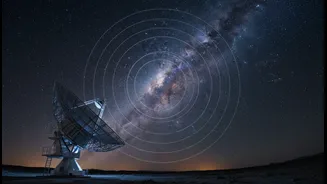
Such a remarkable find did not happen in a vacuum. It was made possible by Rad@home, a pioneering Indian citizen science program founded over a decade ago. The project specifically trains undergraduate students, teachers, and members of the public to analyze real-world astronomical data, primarily from the Giant Metrewave Radio Telescope (GMRT). Its explicit goal is to prove that ordinary citizens can engage in complex research. This is the 'slow training' in action. It is the unglamorous, multi-year effort of developing training modules, mentoring participants, and building a community capable of making meaningful scientific contributions. The discovery is the visible tip of an iceberg, supported by a vast, submerged structure of pedagogical effort.
The Challenge of Building Capacity
While Rad@home is a success story, it also highlights a broader challenge for citizen science in India. Such initiatives are often constrained by significant limitations. Studies and reports on citizen science in India point to a number of systemic issues, including a lack of standardized guidelines for training and data collection, and a need for more sustained institutional support. Projects are often fragmented and struggle with resources, especially in remote regions like the Northeast, where a lack of equipment and trained instructors can hinder progress. Many express interest, but find few opportunities for the kind of hands-on, formal training that builds real skills. This is the critical limit: the desire to participate often outstrips the capacity to properly train and equip participants.
In Praise of 'Slow Science'
This is where the concept of 'slow science' becomes essential. As a movement, slow science argues for valuing quality over quantity, depth over speed, and careful methodology over the pressure for immediate results. It's a deliberate counter to a culture that often demands quick, headline-grabbing outputs. The patient work of training a cohort of citizen scientists is a perfect example of slow science in practice. It is methodical and prioritizes the cultivation of skills and scientific literacy within a community. Its success is not measured by the number of papers published per year, but by the creation of a scientifically engaged public and the generation of reliable, carefully validated data.
Redefining Success for Sikkim
Bringing this lens back to Sikkim, the true victory is not just the discovery of one galaxy. The larger success is the validation of a process. For states like Sikkim, with unique geographical advantages for sky-gazing but also facing developmental and educational challenges, the 'limit' of slow training is actually its greatest asset. The process builds human capital, fosters a scientific temperament, and creates educational pathways that did not exist before. Initiatives in nearby Himalayan regions like Ladakh, which are developing astrotourism by training local youth as 'Astronomy Ambassadors', show the tangible, community-level benefits that come from this long-term investment in people, not just in technology.