




A Cosmic Sweet Spot
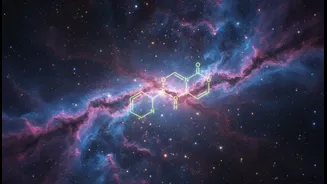
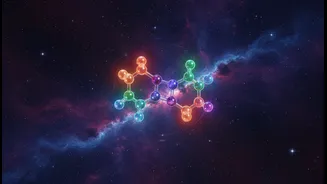
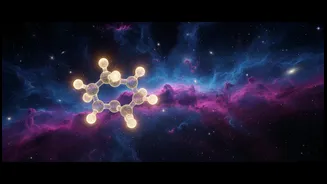
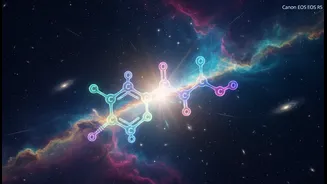
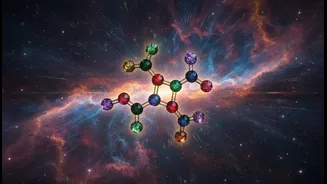
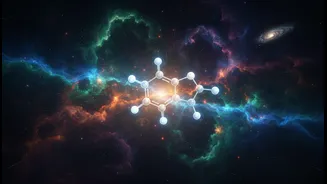
An international team of researchers has identified a four-carbon sugar called erythrulose floating in a giant molecular cloud near the center of our Milky Way galaxy. The discovery was made in a region known as G+0.693−0.027, a vast, dense collection
of gas and dust sitting approximately 26,700 light-years from Earth. This cloud is a known chemical factory, rich in the organic molecules that are the precursors to more complex chemistry. Using powerful radio telescopes in Spain, scientists were able to detect the faint, specific signal emitted by the erythrulose molecule. Every molecule rotates and vibrates at specific frequencies, creating a unique spectral "fingerprint." By matching the signals from the gas cloud to the known fingerprint of erythrulose from laboratory samples, the team confirmed its presence in this stellar nursery.
An Essential Building Block
So, why is finding sugar in deep space such a significant event? Different types of sugars are fundamental to life on Earth. They serve as an energy source for our cells and, most importantly, form the structural backbone of RNA and DNA, the molecules that carry our genetic code. The discovery of erythrulose, a true sugar, suggests that such crucial building blocks for life can form in space before stars and planets even exist. While this specific sugar isn't directly used in DNA, it is part of the chemical family from which more biologically essential molecules, like ribose (the sugar in RNA), can be built. This finding supports the long-held hypothesis that the raw materials for life weren't necessarily created on early Earth but could have been delivered to our planet billions of years ago by comets and meteorites that were seeded with these complex cosmic ingredients.
A Surprisingly Abundant Ingredient
One of the most surprising aspects of the discovery is the amount of erythrulose detected. The study revealed that this four-carbon sugar is at least eight times more abundant than simpler, three-carbon sugars, none of which were detected in the same cloud. This challenges the prevailing view in astrochemistry that complex molecules grow slowly, one carbon atom at a time. Instead, researchers suggest that erythrulose might form more efficiently through the merging of simpler two-carbon molecules, such as aldehydes and alcohols, on the frozen surfaces of interstellar dust grains. In the frigid, low-pressure environment of a molecular cloud, these icy grains act like tiny cosmic laboratories, providing a surface for chemical reactions to occur over millions of years, powered by radiation from nearby stars.
Ingredients, Not the Finished Cake
It is crucial to understand what this discovery does and does not mean. Finding a complex sugar molecule in an interstellar cloud does not mean scientists have found evidence of alien life. It is more like finding a bag of flour in a kitchen; it’s a key ingredient, but it doesn't mean a cake is baking in the oven. The discovery of erythrulose shows that the universe is an effective organic chemist, capable of producing some of life's essential building blocks under the harsh conditions of deep space. It tells us that the ingredients for life are not a limiting factor in the cosmos and could be widespread throughout our galaxy and beyond. While this particular sugar isn't life itself, its presence gives scientists a clear target for future searches. The next major goal is to find even more complex sugars like ribose, the five-carbon sugar that forms the backbone of RNA, which would forge an even more direct link to the chemistry of life as we know it.