


A Cosmic Mystery Appears
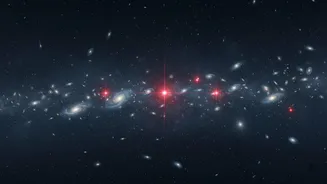
In the stream of breathtaking images from the James Webb Space Telescope (JWST), astronomers began noticing something strange: hundreds of tiny, reddish specks scattered across the most distant reaches of space. Dubbed 'Little Red Dots' (LRDs), these
objects weren't just faint; they were ancient. The light reaching us today shows them as they existed in the universe's infancy, between 600 million and 1.6 billion years after the Big Bang. Their discovery was a genuine surprise. They appeared compact and unusually bright for their age, sparking a major debate and a race to figure out their true nature. What were these mysterious objects that peppered the dawn of cosmic history?
The Great Cosmic Debate
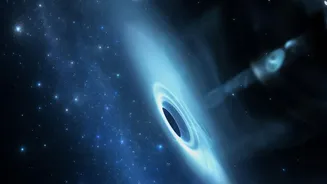
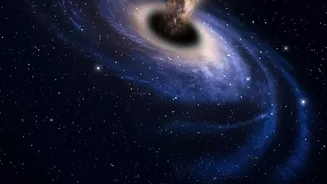
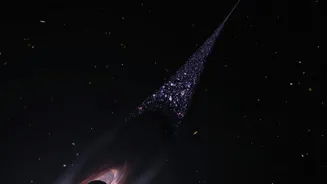
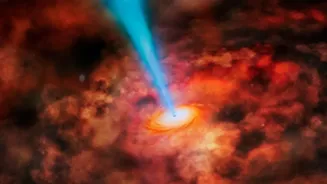
Almost immediately, two main theories emerged, both of them extraordinary. The first idea was that LRDs were incredibly massive galaxies, far larger than models predicted could exist so early in the universe's timeline. The second, and more widely discussed, theory was that they were the glowing hearts of active galactic nuclei (AGN)—supermassive black holes furiously consuming gas and dust. This was also a challenging idea. These black holes seemed far too massive compared to their host galaxies, defying the known relationship between the two. Furthermore, they lacked the tell-tale X-ray signatures expected from such objects, leading to a refined model of 'black hole stars': a black hole so completely shrouded in a dense cocoon of gas that most of its typical radiation was masked.
A Surprising Evolutionary Link
Now, a July 2026 study from astronomers at The University of Texas at Austin has introduced a compelling new possibility, adding fresh context to the debate. Instead of being a strange, extinct class of object, the research suggests that Little Red Dots may not have disappeared at all. Instead, they might have simply evolved into something astronomers know well: globular clusters. These are ancient, dense, spherical collections of hundreds of thousands or even millions of stars that orbit most large galaxies, including our own Milky Way. The study proposes that LRDs are not a separate phenomenon but are, in fact, globular clusters caught in the very process of being born.
From Red Dot to Star Cluster
According to this new model, a forming globular cluster with a theoretical, short-lived 'supermassive star' at its center would have an appearance that perfectly matches the JWST's observations of a Little Red Dot. This elegant solution explains their compact size, their luminosity, and their peculiar colour without needing to rewrite the book on how quickly black holes can form. It also answers the question of why LRDs seem to vanish from the cosmos after about 1.5 billion years. They don't go extinct; they simply cool down and transition into the familiar, gravitationally bound star clusters we see in the universe today. In this view, Webb isn't just seeing a new object, but witnessing the infancy of a well-known one.
Rewriting the Universe's First Chapter
This theory connecting LRDs to globular clusters provides a powerful framework that links an exotic discovery to objects in our own cosmic neighbourhood. However, the scientific jury is still out. Other recent research has provided strong evidence for the black hole model. One study in June 2026 presented the most detailed spectrum of an LRD yet, concluding it was indeed a supermassive black hole in a dense gas cocoon. Another found an LRD that, unlike others, does emit X-rays, suggesting it might be a transitional phase between a shrouded 'black hole star' and a typical AGN. The ongoing investigation into the nature of Little Red Dots is a perfect illustration of science in action, with each new observation from Webb adding another fascinating layer to the story of how the universe began.