


A Fleeting Beauty? The Age Debate
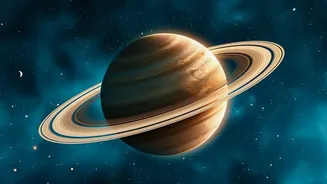
One of the most fundamental questions scientists have about the rings is their age. For a long time, it was assumed they were ancient, forming alongside Saturn itself around 4.5 billion years ago. However, data from NASA's Cassini spacecraft, which studied
the planet for 13 years, suggested they might be surprisingly young—perhaps only 10 million to 100 million years old. This would mean they appeared when dinosaurs still roamed the Earth and that humans are lucky to be living in a time when Saturn is so brilliantly adorned. This 'young rings' theory is based on two key ideas: their mass and their brightness. Scientists believe the rings are too lightweight and their water ice is too pristine and bright to have endured billions of years of bombardment from dark, dusty micrometeoroids. However, this idea has been challenged by recent models suggesting that micrometeoroid impacts might vaporize and clean the rings, rather than darken them, potentially allowing for a much older age. The debate remains one of the most active in planetary science.
More Than Just Ice: A Mysterious Composition
At a glance, Saturn’s rings seem to be made almost entirely of water ice, with particles ranging in size from tiny dust grains to chunks as large as a house. Cassini's observations confirmed they are about 99.9% pure water ice, but it's the remaining fraction that holds so many secrets. During its final orbits, the spacecraft detected a complex cocktail of other materials raining from the rings into the planet's atmosphere. This material included not just rocky silicates, but also surprising organic compounds like methane, ammonia, and carbon monoxide. The presence and distribution of this non-icy 'dirt' is a major puzzle. Some regions, like the Cassini Division, are dirtier than others, which has led to theories that the rings may have formed from the tidal disruption of an icy moon or a captured comet. Understanding this complex chemistry is key to unlocking the story of their origin.
The Puzzle of 'Ring Rain'
The Cassini mission confirmed a bizarre phenomenon known as 'ring rain,' where particles from the rings are pulled inward by Saturn’s gravity and magnetic field, falling into the planet's upper atmosphere. This constant shower of material is not just a trickle; scientists estimate that thousands of kilograms of ring matter are lost every second. This process has a significant impact, heating Saturn's upper atmosphere and changing its chemical composition. The existence of ring rain raises another pressing question: if the rings are constantly losing mass, how long can they last? Current estimates suggest the entire ring system could disappear in as little as 100 million to 300 million years—a fleeting moment in cosmic time. This relatively rapid decay supports the theory that the rings are a temporary, youthful feature.
Ghostly Spokes and Unexplained Structures
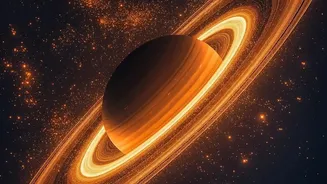
Beyond their broad structure, the rings host a variety of strange, transient features that defy easy explanation. Among the most mysterious are the 'spokes'—dark, radial features that appear and disappear over a few hours, stretching for thousands of kilometers. First spotted by the Voyager spacecraft in the 1980s, these ghostly marks are now being monitored by the Hubble Space Telescope. The leading theory is that they are caused by Saturn's magnetic field interacting with the solar wind, electrostatically levitating fine dust particles above the main ring plane. These spokes appear to be seasonal, becoming more frequent as Saturn approaches its equinox. The rings also have an incredibly intricate structure of gaps and waves, created by the gravitational pull of Saturn's many moons, but some gaps remain unexplained.