





First, What Is a Pulsar?
When a massive star dies in a supernova, it can leave behind an incredibly dense core called a neutron star. Some pack more mass than our sun into a sphere only about 25 kilometers wide. Many of these neutron stars are also pulsars, which get their name
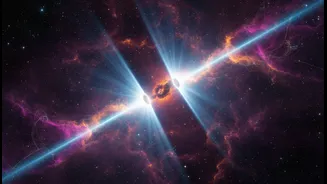
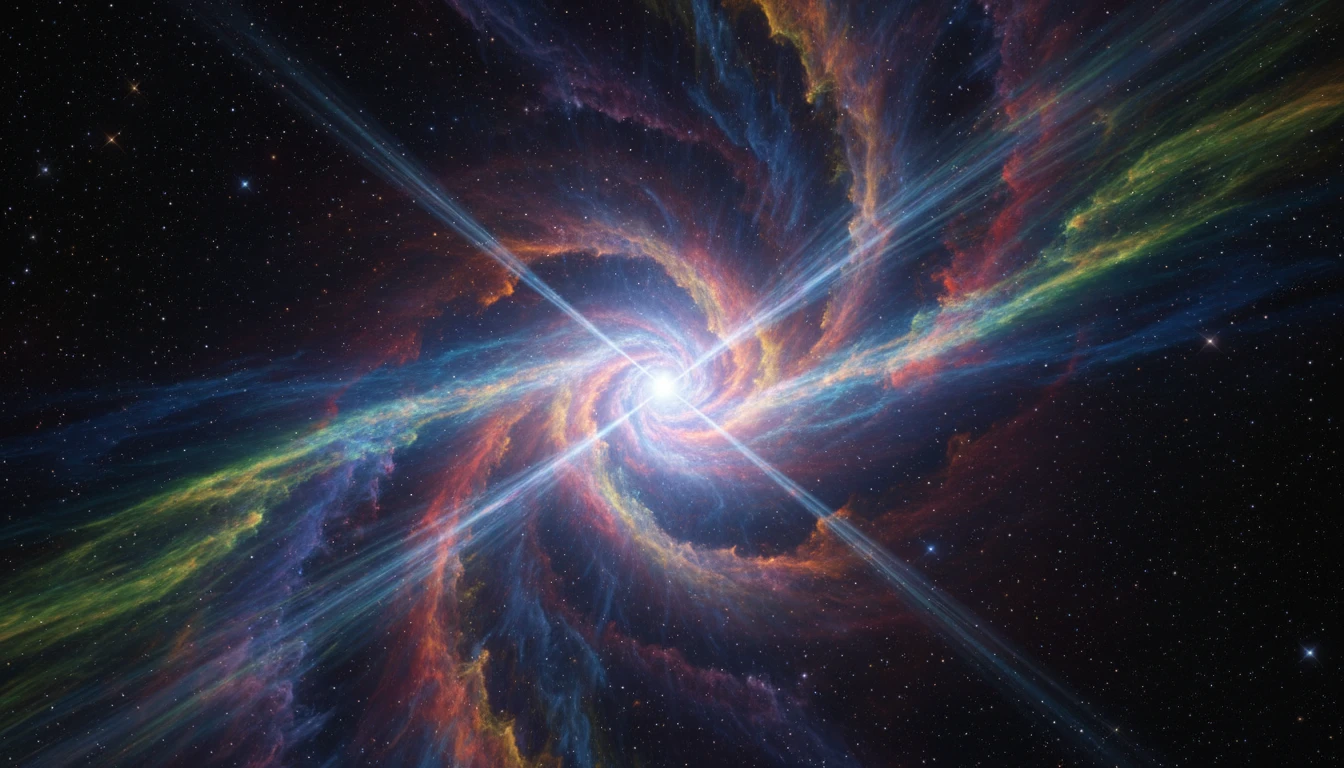
from the pulsating beams of radiation they emit. This isn't because the star is turning on and off; it's because it spins rapidly, sweeping beams of energy from its magnetic poles across the cosmos. If one of those beams sweeps past Earth, we see a regular 'pulse,' much like a sailor seeing the beam of a distant lighthouse.
The Textbook Model
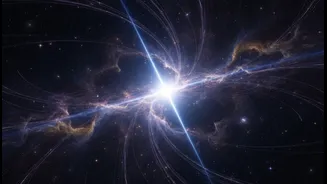
For decades, the standard picture of a pulsar was simple and elegant. It was imagined to have a powerful magnetic field like a giant bar magnet, with a north and south pole. This field is astoundingly strong, trillions of times more powerful than Earth's. It's so intense that it rips charged particles from the star's surface and accelerates them. These particles would then stream along the magnetic field lines and slam back into the surface at the opposite magnetic pole, creating two very bright, very hot spots. As the star spun, these two opposing hot spots would rotate in and out of view, creating the lighthouse effect we observe. It was a neat theory, but as we’re learning, the universe is rarely that simple.
NASA's New Map Changes Everything
To get a better look, NASA used the Neutron star Interior Composition Explorer (NICER), a telescope mounted on the International Space Station. By precisely timing the arrival of X-rays from a pulsar named J0030, located 1,100 light-years away, scientists could create the first-ever surface map of a neutron star. What they found shattered the old model. Instead of two neat, opposing hot spots, J0030 showed a much stranger and more complex pattern. Two independent teams of scientists analyzed the data and came to similar, startling conclusions.
A Surprisingly Lumpy Star
The NICER map revealed that all of J0030's hot spots are in its southern hemisphere. One team's model showed two spots: one small and circular, the other a long, crescent shape. The other team's model suggested two or three oval-shaped spots. Far from the simple two-pole model, this suggested the pulsar's magnetic field is much more complicated, not at all like a simple bar magnet. The hot spots are where the magnetic field lines emerge from the star's surface, so their strange shapes and locations mean the field itself must be tangled and complex.
Guiding Particles on a New Path
This brings us back to the energetic particles. These particles are charged, so they are forced to travel along the lines of the magnetic field. In the old model, this was a straightforward trip from one pole to another. But with a more complex field, like the one revealed by NICER on J0030, the paths these particles take are also more complex. Instead of simple arcs, the field lines likely loop and twist in unexpected ways, guiding the particle blizzards along these more convoluted routes. The 'Lighthouse Map,' therefore, doesn't just show us the surface; it gives us a blueprint of the invisible magnetic structures that create the pulsar's weather and guide its powerful emissions through space.