





How Microwaves Actually Work
First, let's be clear about what’s happening inside that metal box. A microwave oven uses a device called a magnetron to generate microwaves, a type of electromagnetic radiation similar to radio waves. These waves flood the inside of the oven and are
particularly good at being absorbed by water, fats, and sugars. When the waves hit the food, they cause the water molecules within it to vibrate rapidly. Think of it as making the molecules twist back and forth billions of time per second. This frantic molecular motion creates friction, and that friction generates the heat that cooks your food. It’s not about making the food itself “radioactive,” but simply about turning electrical energy into heat by exciting molecules.
The Real Culprit: Standing Waves
So if the oven is filled with waves, why isn’t the heating perfectly even? The main reason is a phenomenon called “standing waves.” The microwaves don't just travel in a straight line; they bounce off the metal interior walls of the oven. As these reflected waves interfere with the incoming waves, they create a fixed pattern of high-energy and low-energy zones. The high-energy spots are called “antinodes,” and this is where food gets heated intensely. The low-energy spots, where the waves effectively cancel each other out, are called “nodes,” and any food sitting in these zones will remain cold. This is why microwave heating often occurs in patches, creating those dreaded hot and cold spots.
Busting the 'Inside Out' Myth
There's a persistent myth that microwaves cook food from the inside out. According to the U.S. Food and Drug Administration (FDA), this isn't true. Microwaves can only penetrate food to a depth of about 1 to 1.5 inches. In thick items, like a dense piece of meat or a large potato, the outer layers are heated directly by the microwaves. The centre then cooks primarily through conduction, as heat from the hotter outer layers slowly travels inward. This is also why the edges of your food often get much hotter than the middle—they are being hit by microwave energy from multiple directions, while the centre has to wait for the heat to arrive.
The Hero of Your Microwave: The Turntable
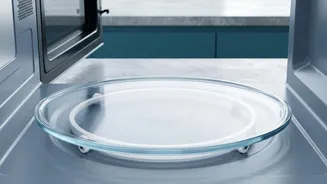
The turntable isn't just there for show; it's the primary defence against the unevenness caused by standing waves. By rotating your food, the turntable ensures that every part of the dish moves through both the hot spots (antinodes) and cold spots (nodes). This constant motion helps to average out the energy absorption, leading to more uniform heating. If your turntable isn’t rotating, your food will sit stationary in that fixed energy pattern, resulting in some parts being overcooked while others remain chilly. Some modern ovens without turntables use a “mode stirrer,” a small metal fan that reflects and scrambles the microwaves to achieve a similar effect of distributing the energy more evenly.
Tips for More Even Heating
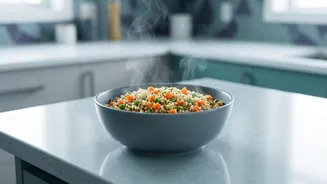
While you can’t change the physics, you can work with it. For more even results, try arranging your food in a ring or donut shape on the plate, leaving a space in the middle. This avoids the centre, which is often a cooler spot, and allows waves to hit the food more uniformly. Placing your dish closer to the edge of the turntable, rather than directly in the centre, also helps, as the edges travel a greater distance and pass through more varied energy zones. Finally, one of the most effective methods is to simply stop the microwave halfway through the cooking time to stir liquids or rotate solid foods. And always follow the instruction to let food “stand” for a minute or two after cooking; during this time, heat continues to conduct from the hotter parts to the cooler parts, helping the temperature to even out.