




The Big Picture Telescope
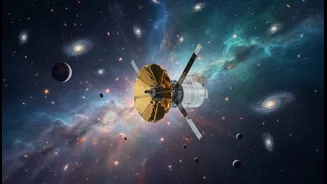
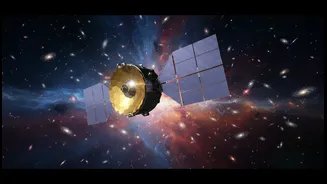
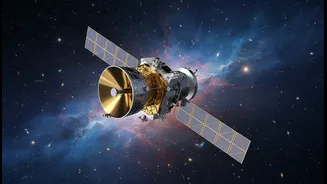
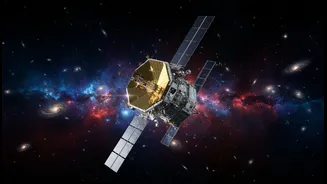
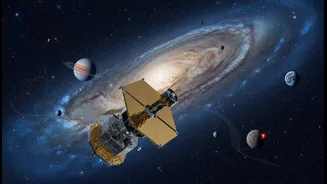
Scheduled for launch on August 30, 2026, the Nancy Grace Roman Space Telescope is NASA's next flagship mission, designed to tackle some of the biggest questions in astrophysics. Unlike the Hubble or James Webb Space Telescopes (JWST), which are masters
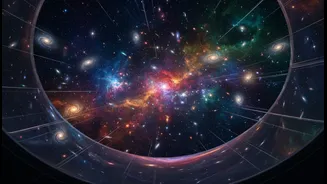
of the deep, narrow-field view, Roman is a survey specialist. Its primary strength lies in its incredible field of view. Equipped with a 300-megapixel Wide Field Instrument, Roman can capture a patch of sky at least 100 times larger than Hubble can in a single snapshot, all while maintaining similar sharpness. Imagine trying to take a picture of a massive crowd. Hubble and Webb would zoom in to capture individual faces with stunning detail. Roman, on the other hand, is designed to take a sweeping panorama of the entire crowd, quickly and efficiently. This capability will allow it to map the universe thousands of times faster than its predecessors.
The Scientific Payoff: Dark Universe and New Worlds
Roman's scientific goals are ambitious, focusing on two key areas: understanding dark energy and dark matter, and discovering thousands of new exoplanets. It will investigate the mysterious force known as dark energy, which is causing the universe's expansion to accelerate, by measuring its effects on cosmic structures over time. To do this, Roman will use techniques like weak gravitational lensing and observations of distant supernovae. It will also conduct a massive census of exoplanets using a technique called gravitational microlensing. This method is sensitive enough to find planets down to the mass of Mars, including rogue planets that don't orbit a star. It's predicted that Roman could discover around 100,000 new exoplanets, potentially more than all other telescopes combined have found to date. The telescope also carries a technology demonstrator, the Coronagraph Instrument, designed to block starlight to directly image planets orbiting nearby stars—a key step toward future missions that will search for habitable worlds.
The Cost of a Cosmic Surveyor
A flagship mission comes with a flagship price tag. The total lifecycle cost for the Nancy Grace Roman Space Telescope is estimated at around $4.3 billion. This figure includes development, launch, and five years of science operations. The launch itself, awarded to SpaceX for its Falcon Heavy rocket, costs approximately $255 million. While a significant investment, the project has been noted by NASA officials for running ahead of schedule and under its cost cap. The telescope's primary mirror, at 2.4 meters, is the same size as Hubble's. This isn't a coincidence; the mirror was repurposed after being donated to NASA by the National Reconnaissance Office, which helped manage the initial costs of a fresh design. Still, the mission has faced budget proposals seeking its cancellation in the past, highlighting the financial pressures and difficult choices inherent in funding large-scale science projects.
Understanding the Limits and Trade-Offs
Roman is a powerful tool, but it's not a do-everything observatory. Its primary limitation is its design as a survey instrument. While it sees wide, it doesn't see as deep or in the same wavelengths as the James Webb Space Telescope. JWST is optimized to detect the faint, extremely redshifted infrared light from the universe's first galaxies. Roman observes in visible and near-infrared light, making it unsuited for that specific task. Its cooling systems are also less complex than Webb's, as it doesn't need to be as cold to prevent its own heat from interfering with observations. This is a deliberate trade-off. Roman is not a replacement for Hubble or Webb but a powerful complement. Its role is to be the wide-angle scout, identifying vast numbers of interesting targets—be they unusual galaxies, supernovae, or exoplanets—which Webb and other telescopes can then study in greater detail. It will generate enormous catalogues of cosmic objects, creating a wealth of data for the entire astronomical community to explore for decades.