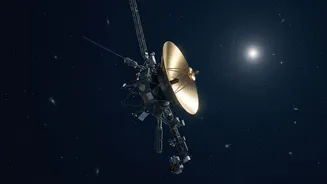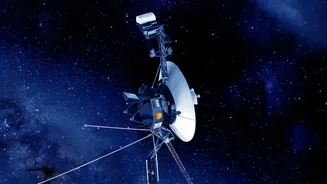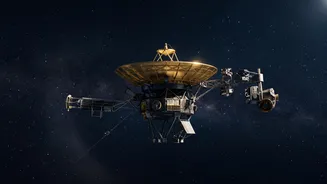

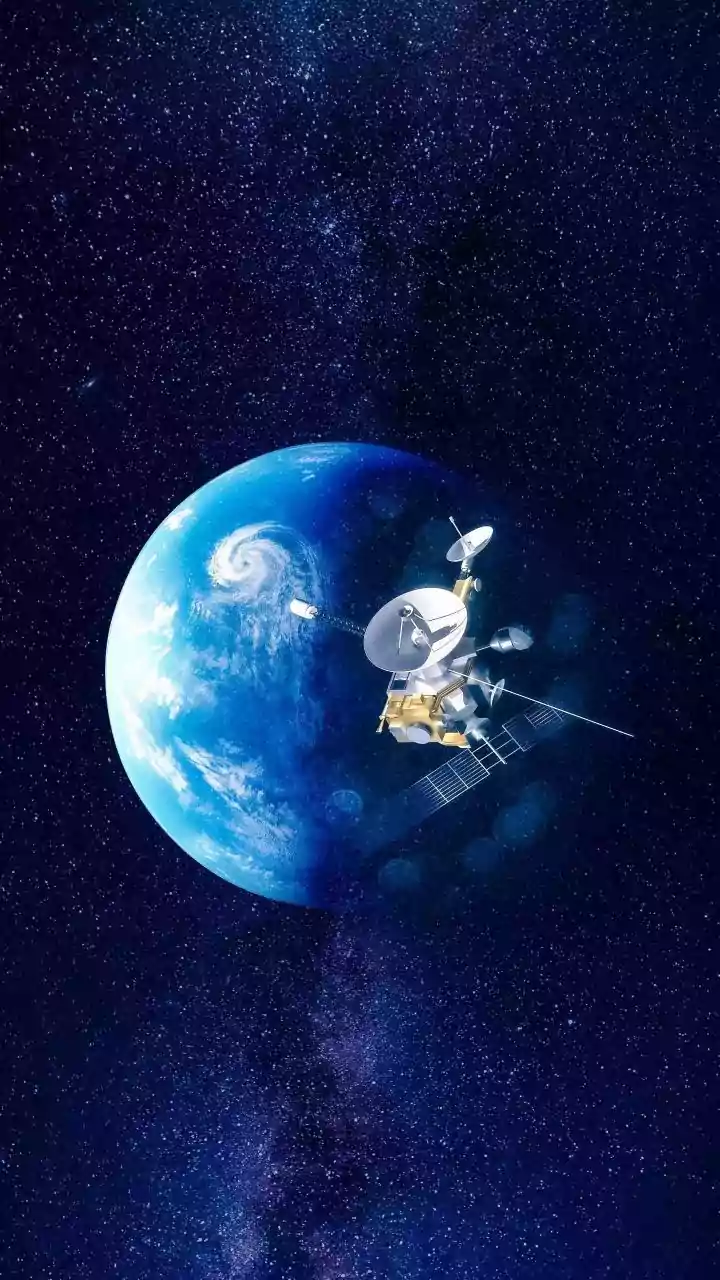
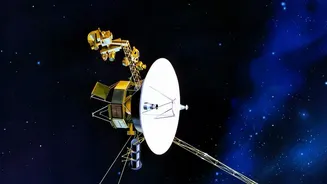
Launched in 1977, NASA's Voyager 1 is humanity’s most distant traveler. Now, after nearly five decades journeying through the cosmos, it’s about to cross a mind-boggling new milestone: a distance of one light-day from Earth.
What Exactly Is a Light-Day?
A light-day isn't a measure
of time, but of distance. It's how far a particle of light travels in a vacuum in 24 hours. Given that light moves at about 299,792 kilometers per second, a light-day is a staggering 25.9 billion kilometers (or about 16.1 billion miles). To put that into perspective, it takes light from the Sun just over eight minutes to reach Earth. For a signal from Earth to reach Voyager 1, it will soon take a full 24 hours. This means a simple round-trip communication — sending a command and receiving confirmation — will take two days. The spacecraft is set to cross this symbolic boundary on November 18, 2026, becoming the first human-made object to do so.
A Mission for the Ages
Voyager 1, along with its twin Voyager 2, launched in 1977 on a mission to explore the outer solar system. It completed its primary objectives decades ago, conducting historic flybys of Jupiter in 1979 and Saturn in 1980. During these encounters, it made groundbreaking discoveries, including active volcanoes on Jupiter's moon Io and the intricate details of Saturn's rings. After its Saturn flyby, Voyager 1 used the planet's gravity to slingshot itself upward, out of the plane of the planets, on a trajectory toward the vast emptiness between the stars. In February 1998, it officially became the most distant human-made object, surpassing Pioneer 10.
Into the Great Unknown
The probe's most significant achievement came in August 2012, when it crossed the heliopause — the boundary where the Sun’s stream of charged particles gives way to the interstellar medium. It had officially entered interstellar space, the first object from Earth to do so. Even now, nearly 50 years after launch, Voyager 1 continues to send back invaluable data about the space between stars. Its remaining active instruments, a magnetometer and a plasma wave subsystem, measure the magnetic fields and 'hear' the vibrations of interstellar plasma, giving scientists their only direct measurements of this unexplored region.
Keeping a Legend Alive
Keeping a nearly 50 year old spacecraft operational is a monumental challenge. Voyager $^$1's nuclear power source, which produced $^$470 watts at launch, dwindles by about $^$4 watts each year. To conserve energy, NASA engineers have been systematically shutting down instruments. In $^$2026 alone, the team completed a delicate power $^$shuffling maneuver nicknamed the 'Big Bang' to extend the probe's life. Despite these efforts and a few communication scares, the probe remains active. Mission scientists hope to keep at least one instrument running into the $^$2030s, squeezing every last bit of data from this historic mission before it inevitably falls silent forever.