




The Soaring Energy Demand
Every time you stream a video, join a conference call, or use an AI application, a data centre somewhere is working hard. These facilities are the backbone of the digital age, but they are incredibly power-hungry. Globally, data centres already consume
1-2% of all electricity, a figure comparable to the entire airline industry. The rise of Artificial Intelligence (AI) is pushing this demand to unprecedented levels. An AI-powered server rack can draw up to 120 kilowatts (kW) of power, compared to just 5-10 kW for a traditional one. In India, the data centre market is expanding at a blistering pace. Electricity demand from this sector is projected to surge from around 13 terawatt-hours (TWh) in 2024 to as high as 91 TWh by 2035. This explosive growth puts immense strain on the energy grid and challenges India’s goal of achieving net-zero emissions by 2070, making sustainability a critical business and environmental priority.
Efficient Servers: The Brains of the Operation
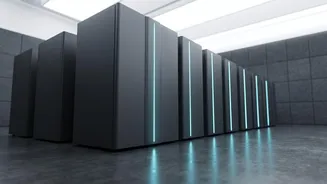
At the heart of any data centre are its servers. Traditionally, the focus was on maximizing processing power, but now the emphasis is shifting to performance per watt. Modern energy-efficient servers are engineered to minimize power consumption without sacrificing performance. This is achieved through several key innovations. Low-power processors, such as certain models from AMD and other specialized chipmakers, can dramatically reduce energy use at the source. Furthermore, strategies like server virtualization allow one physical server to run multiple virtual machines, consolidating workloads and slashing the number of active machines. This reduces not just direct power consumption but also the associated cooling costs. For businesses, adopting these technologies translates directly into lower operational expenses and a smaller carbon footprint, a crucial advantage in a competitive market.
Better Cooling: Beating the Digital Heatwave
All those servers working 24/7 generate a tremendous amount of heat, and managing it is one of the biggest energy drains in a data centre, accounting for nearly 40% of total power use in some cases. Traditional air conditioning is proving inefficient, especially as AI workloads create denser, hotter server racks. The industry is now rapidly pivoting to liquid cooling. Unlike air, liquids are far more effective at transferring heat. Technologies like 'direct-to-chip' cooling use pipes to deliver a coolant directly to the hottest components like CPUs and GPUs, absorbing heat at the source. Another method, 'immersion cooling', involves submerging entire servers in a non-conductive fluid. These advanced systems can reduce cooling-related energy consumption by up to 90% compared to traditional air-based methods, offering massive cost savings and efficiency gains.
Reliable Clean Electricity: The 24/7 Power Challenge
A sustainable data centre is only as green as its power source. Given their need for uninterrupted, 24/7 power, simply connecting to a grid that relies on fossil fuels isn't enough. The solution lies in sourcing reliable, clean electricity. In India, major tech giants like Google, Amazon, and Meta are leading the way by signing long-term Power Purchase Agreements (PPAs) directly with renewable energy developers. These agreements allow them to fund new solar and wind farms, securing a fixed, long-term price for green energy that is often cheaper than variable grid tariffs. However, because solar and wind are intermittent, ensuring 99.999% uptime is a major challenge. This is driving innovation in hybrid solutions that combine renewable generation with battery energy storage systems (BESS) and other firm power sources to guarantee a constant, clean flow of electricity day and night.