
A Strategic Alliance in the Stars
The India-U.S. space relationship has moved far beyond its historical tensions, transforming into a strategic necessity for both democracies. Driven by shared interests in scientific discovery, economic opportunity, and geopolitical stability, this partnership
is a cornerstone of the broader U.S.-India initiative on Critical and Emerging Technology (iCET). The collaboration aims to combine America's established space industry with India's rapidly growing and cost-effective capabilities. This synergy is not just about launching rockets; it's about setting new rules for space, ensuring peaceful exploration, and countering the ambitions of other global powers. For India, it provides access to cutting-edge technology and a seat at the table in defining the future of global space governance, marking a significant shift from its traditional non-alignment stance.
NISAR: A Game-Changer for Earth Observation
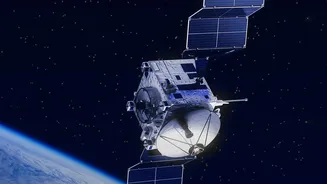
The centerpiece of this collaboration is the NASA-ISRO Synthetic Aperture Radar (NISAR) mission, which launched successfully in July 2025. Hailed as the most sophisticated radar satellite ever built, NISAR is a joint Earth-observing mission designed to monitor our planet's changing surface with unprecedented accuracy. The satellite is equipped with two radar systems—NASA's L-band and ISRO's S-band—that allow it to scan nearly all of Earth's land and ice surfaces twice every 12 days, regardless of weather or daylight. After deploying its massive 12-meter antenna, the satellite entered its science phase in late 2025. Its data will be a game-changer for monitoring natural disasters like earthquakes and landslides, tracking changes in glaciers and sea levels, and managing agricultural resources. The information, which is publicly available, will provide critical insights for addressing climate change and improving disaster response worldwide.
To the Moon and Beyond: The Artemis Accords
In 2023, India became a signatory to the Artemis Accords, a U.S.-led set of principles for safe, transparent, and sustainable exploration of the Moon and beyond. This move aligns India with a growing international coalition dedicated to collaborative lunar exploration. The partnership opens the door for ISRO to participate in future Artemis missions, including the Lunar Gateway—a planned space station in lunar orbit—and efforts to establish a permanent human base on the Moon's south pole. In August 2026, NASA formally invited ISRO to join its Moon Base program, a significant step that builds on the success of missions like Chandrayaan-3. By joining the Accords, India ensures its space program remains technologically compatible with global standards and avoids isolation, positioning itself to help write the rules for the next era of space activity.
The Human Element: Astronauts and Space Stations
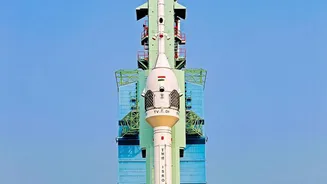
The partnership extends to human spaceflight, a key priority for India's Gaganyaan mission. Under a new framework for cooperation, NASA is providing advanced training to ISRO astronauts at its Johnson Space Center. This collaboration is set to culminate in a joint mission to the International Space Station (ISS), which will mark a historic first for the two nations. While ISRO develops its own capabilities for human spaceflight, this joint effort provides invaluable experience in long-duration missions and on-orbit scientific research. Beyond the ISS, the collaboration sets the stage for future joint human missions, potentially to the Lunar Gateway or even Mars, while India also plans to launch the first module of its own space station by 2028.
Commercial Frontiers and Future Tech
Both nations recognize that the future of space is increasingly commercial. The U.S.-India partnership is actively fostering collaboration between their private space sectors, from startups to established aerospace giants. This includes joint work on satellite technologies, space situational awareness, and deep-space communications. The goal is to align India's burgeoning startup ecosystem with the experienced U.S. commercial space model, creating new economic opportunities and high-tech jobs in both countries. As commercial ventures like Starlab develop the next generation of space stations, there will be even more opportunities for Indian scientists and companies to participate in the growing low-Earth orbit economy.