




More Than Just a Big Bang
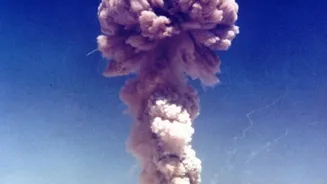
In the vacuum of space, a nuclear explosion behaves very differently than it does on Earth. There's no atmosphere to create a mushroom cloud or a powerful shockwave. Instead, the primary dangers come from an invisible, instantaneous flood of radiation
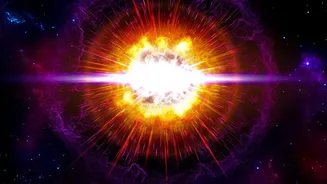
and electromagnetic energy. For spacecraft, the problem isn't the physical blast; it's the cocktail of high-energy particles and pulses that follows. A high-altitude nuclear explosion, or HANE, unleashes gamma rays and X-rays that can fry sensitive electronics from hundreds or even thousands of kilometres away. Scientists study this not to be alarmist, but to understand the profound vulnerabilities in the space-based infrastructure that underpins everything from GPS navigation and financial transactions to weather forecasting.
The Triple Threat to Satellites
The disruption from a HANE unfolds in three distinct and devastating phases. The first is the High-Altitude Electromagnetic Pulse (HEMP). In the initial nanoseconds, gamma rays from the detonation strike the upper atmosphere, stripping electrons from air molecules. The Earth's magnetic field then deflects these free electrons, causing them to spiral and emit a massive, continent-spanning pulse of electromagnetic energy. For any satellite in the line of sight, this pulse can induce crippling voltage surges, effectively acting like a gigantic lightning strike that overloads and destroys its internal circuits. This initial flash is just the beginning of the assault on orbiting systems.
An Attack From Within
The second threat is more insidious: System-Generated Electromagnetic Pulse (SGEMP). While a satellite's outer hull might shield it from some of the initial EMP, it can't block all the penetrating gamma and X-rays from the blast. When these high-energy photons strike the metallic skin and internal components of the satellite, they knock electrons loose from the surfaces inside the spacecraft itself. This creates a powerful electrical field within the satellite's own casing, generating a localised EMP that can arc between components and fry the delicate microelectronics it was designed to protect. Essentially, the satellite's own body becomes a source of its destruction, a threat that is particularly potent in the vacuum of space.
The Lingering Killer: An Artificial Radiation Belt
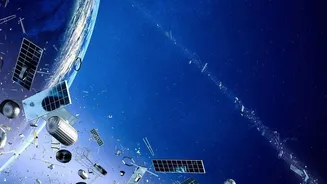
Perhaps the most catastrophic and long-lasting consequence is the creation of an artificial radiation belt. Beta particles—energetic electrons released by the decay of radioactive fission fragments—become trapped by the Earth's magnetic field. These particles don't just dissipate; they form a new, intense belt of radiation that can persist for months or even years. Every satellite in low-Earth orbit is forced to fly through this deadly zone again and again. With each pass, the cumulative radiation dose degrades solar panels and damages sensitive electronics, leading to eventual failure. A recent, non-peer-reviewed study projected that a single 1-megaton detonation could disable about 98% of low-Earth orbit satellites within a week, mostly due to this lingering radiation effect.
A Lesson From History: Starfish Prime
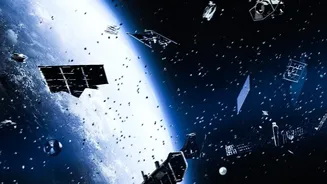
This isn't just theoretical. On July 9, 1962, the United States conducted the Starfish Prime test, detonating a 1.4-megaton warhead 400 kilometres above the Pacific Ocean. The results were immediate and sobering. The EMP knocked out streetlights and telephone systems in Hawaii, over 1,300 kilometres away. More importantly, the test created a powerful artificial radiation belt that damaged or destroyed at least a third of the satellites in orbit at the time, which numbered only a few dozen. Satellites like the UK's Ariel-1 and the pioneering Telstar 1 communications satellite failed months ahead of schedule due to radiation damage from the belt. Today, with over 13,000 satellites in low-Earth orbit, a similar event would be exponentially more devastating.