



The Challenge of Lunar Life Support
For future astronauts living and working in a lunar base as part of NASA's Artemis program, oxygen is more than just essential for breathing; it's also a critical component of rocket propellant. The cost and complexity of launching heavy, life-sustaining
resources from Earth are astronomical. Every kilogram of payload is meticulously planned and expensive, making resupply missions for a permanent base a significant hurdle. To make long-duration stays on the Moon feasible, explorers need a way to generate their own essential supplies. This strategy, known as in-situ resource utilization (ISRU), is at the heart of NASA's plans for a sustainable lunar economy and presence.
Mining the Moon for Oxygen
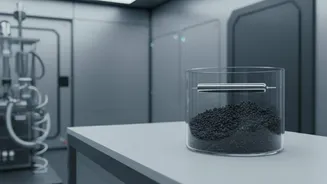
While the Moon has no atmosphere to speak of, its surface is surprisingly rich in oxygen. The lunar soil, a fine powder of crushed rock and dust called regolith, is made of approximately 45% oxygen by weight. However, this oxygen is not freely available. It is chemically bound within oxide minerals, the same way oxygen is locked inside rocks on Earth. The key, therefore, isn't finding the oxygen, but breaking it out of its mineral prison. For years, scientists have theorized about methods to extract this trapped oxygen, and recent technological advancements are finally turning those theories into tangible prototypes.
How the Technology Works
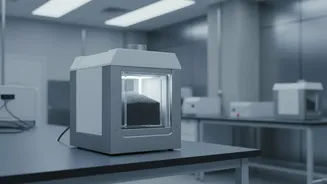
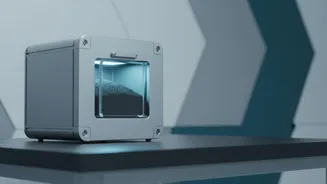
NASA is focusing on a process called carbothermal reduction to crack open the lunar regolith. In recent tests for a project known as the Carbothermal Reduction Demonstration (CaRD), engineers used a powerful reactor to heat simulated moon dust to temperatures exceeding 1,600°C. At these extreme temperatures, the regolith melts. The process then uses a reducing agent like methane to strip the oxygen atoms from the metal oxides in the molten soil. This chemical reaction releases carbon monoxide (CO) gas. In a subsequent step, this carbon monoxide can be processed to separate the oxygen, providing breathable air and leaving behind carbon that can be recycled for the process. Recent integrated tests have successfully used solar concentrators to provide the intense heat, proving that the sun's energy could power this entire operation on the lunar surface.
A Game-Changer for Artemis
The success of the CaRD project is a pivotal development for NASA’s Artemis program, which aims to establish the first long-term human base on the Moon. The ability to generate oxygen on-site would revolutionize mission architecture. It would not only provide a constant supply of breathable air for habitats but could also be used to create rocket propellant for trips back to Earth or for missions deeper into space, such as to Mars. According to NASA engineers, a system based on this technology has the potential to produce several times its own weight in oxygen per year, enabling a truly sustained human presence far from home. This reduces dependence on Earth and dramatically cuts the cost and risk of deep space exploration.
What’s Next for Lunar Oxygen?
Recent tests successfully produced carbon monoxide from the regolith simulant in a vacuum chamber, a critical milestone that proves the core process works under lunar-like conditions. The next phase involves refining the system, scaling it up, and developing the downstream technology that will efficiently convert the carbon monoxide into pure oxygen. Teams at NASA's Johnson Space Center and Kennedy Space Center are collaborating with commercial partners like Sierra Space to advance the reactor technology. While challenges remain, such as ensuring the hardware can withstand the harsh lunar environment and fine-tuning the solar power systems, these successful demonstrations mark a significant leap forward in making a permanent lunar settlement a reality. The same principles could even be adapted for Mars, where the carbon dioxide atmosphere could be converted into oxygen and methane for fuel.