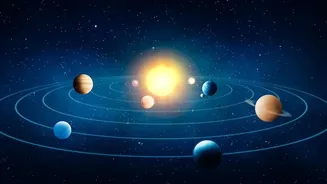


If you picture the solar system, you probably imagine planets moving in perfect circles. For centuries, so did astronomers. But the reality is a bit more stretched out: planets travel along ovals, or ellipses. Here's why that happens.
An Ancient Belief in Circles
For thousands of
years, philosophers and astronomers believed that the heavens were a place of perfection. To ancient Greek thinkers like Plato and Aristotle, the circle was the most perfect shape, so it was natural to assume that the Sun, Moon, and planets moved in circular paths around the Earth. This idea dominated Western thought for over a millennium. Even when Nicolaus Copernicus proposed that the Earth and other planets actually revolved around the Sun, he held onto the idea of perfect circular orbits. The problem was that these models, while elegant, didn't perfectly predict the planets' movements in the sky. To make the observations fit, astronomers had to add complex layers of circles upon circles, known as epicycles.
Kepler's Revolutionary Ellipse
The major breakthrough came in the early 17th century from German astronomer Johannes Kepler. Using a treasure trove of incredibly precise observational data collected by his mentor, Tycho Brahe, Kepler tried to map the orbit of Mars. No matter how he arranged the circular orbits, the data wouldn't fit. After years of painstaking calculations, he abandoned the long-held belief in circles and tested a different shape: the ellipse. It was a perfect match. This led to his first law of planetary motion: planets move in elliptical paths with the Sun not at the center, but at one of two points inside the ellipse called foci. This meant a planet's distance to the Sun is constantly changing as it orbits.
The Cosmic Tug-of-War
Kepler described what was happening, but it took Sir Isaac Newton to explain why later that century. The answer lies in the beautiful interplay between two fundamental forces: gravity and inertia. Newton's law of universal gravitation states that every object in the universe attracts every other object. The Sun exerts a constant gravitational pull on the planets, preventing them from flying off into space. At the same time, each planet has inertia—a tendency to continue moving in a straight line at a constant speed. An orbit is essentially a balancing act. The planet is always trying to move straight ahead, while the Sun's gravity is always pulling it inward. This cosmic tug-of-war is what bends the planet's path into an orbit.
Why an Ellipse and Not a Circle?
So, why does this cosmic dance result in an ellipse? A perfect circle is a very specific, idealized case that requires a planet to have a precise velocity and distance to perfectly balance the star's gravity at all times. Any deviation from that exact speed results in an elliptical orbit. Think of it like throwing a ball horizontally from a very tall tower. If you throw it too slowly, it will fall to Earth. If you throw it at just the right speed, it could theoretically enter a perfectly circular orbit. But if you throw it slightly faster, it won't escape gravity, but it will travel further away before being pulled back, creating an oval path. In the chaotic formation of a solar system, with countless gravitational interactions and objects moving at different speeds, the conditions for a perfect circle are extremely unlikely to occur naturally.
Not All Ovals Are Equal
The 'stretched-out' nature of an ellipse is measured by a value called eccentricity. An eccentricity of 0 is a perfect circle, while a value between 0 and 1 represents an ellipse. The closer the eccentricity is to 1, the more elongated the orbit. The orbits of most planets in our solar system are actually very close to being circular. Venus and Neptune have the least eccentric orbits. Earth’s orbit is also nearly circular, with an eccentricity of just 0.0167. If you were to draw it to scale, it would be almost impossible to distinguish from a perfect circle with the naked eye. Other objects, like Mercury and many comets and dwarf planets, have much higher eccentricities, meaning their oval paths are far more noticeable.