

A Giant New Shape Has Emerged
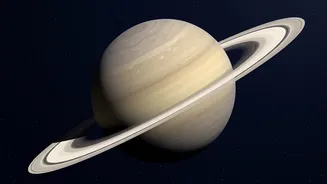
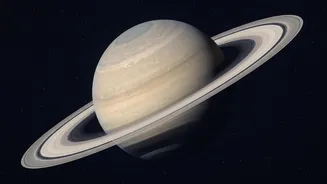
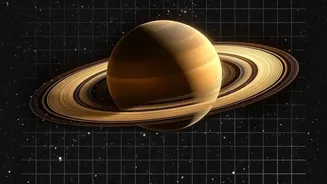
In a major surprise, recent images from the Hubble Space Telescope have revealed a colossal 10-sided atmospheric wave, or 'decagon', churning around Saturn's south pole. Announced in early September 2026, this is the first time a large, regular-sided
geometric pattern has ever been observed in the planet's southern hemisphere. Before this, scientists had looked for a southern counterpart to Saturn's northern storm for years without success. The discovery came after Saturn's long seasons, which last over seven Earth years, tilted the south pole back into view for telescopes on and around Earth. This gave astronomers, both professional and amateur, their first clear look at the region in over a decade, unveiling a feature no one was sure could even exist.
It Has a Famous Older Sibling: The Hexagon
The discovery of the decagon is so significant because Saturn is already famous for a similar, long-standing mystery: the hexagon at its north pole. First spotted by the Voyager spacecraft in the 1980s, the northern hexagon is a six-sided jet stream roughly 32,000 kilometres wide — so large that multiple Earths could fit inside it. This bizarrely geometric storm has remained stable for over 40 years, rotating with the planet and captivating scientists. For years, it was considered a one-of-a-kind oddity. The prevailing theory is that these shapes are formed by a jet stream meandering at a specific latitude, where turbulence and smaller eddies force the airflow into a stable, polygonal pattern. The new decagon suggests this might be a more fundamental behaviour of Saturn's atmosphere than previously thought.
It Appears to Be a Recent Development
Perhaps the most exciting part for scientists is that the decagon appears to be brand new. By reviewing years of Hubble data, researchers found that faint hints of the structure only began to emerge in 2023, becoming much more distinct in observations from 2024 and 2025. This is a stark contrast to the northern hexagon, which has been a persistent feature for as long as we have been able to observe it. The Cassini spacecraft, which orbited Saturn from 2004 to 2017, saw no evidence of this decagon. This offers planetary scientists a rare opportunity: the chance to watch a massive atmospheric phenomenon form and evolve on another world, potentially helping them understand the conditions that give rise to these giant, geometric storms.
It's Not Just Cloud-Deep
Like its northern counterpart, the southern decagon is far more than a superficial pattern in the top layer of clouds. Observations show that the feature is a towering, vertically extended atmospheric structure. By using different light wavelengths, which probe different altitudes in Saturn's atmosphere, scientists can see that the decagon's form persists deep into the planet. This confirms it is a fundamental part of the atmospheric dynamics in the region, a massive wave embedded within one of Saturn's powerful jet streams. The jet stream itself moves at incredible speeds, but the decagon pattern moves much more slowly, behaving like a stable wave riding on a powerful current.
Scientists Are Scrambling for Answers
The decagon's sudden appearance raises more questions than it answers. Why did it form now, when nothing similar was seen for decades? Why does the south pole have a 10-sided feature while the north has six? The discovery challenges existing models of planetary atmospheres and sends scientists back to the drawing board to figure out the exact mechanisms at play. The two polar storms are similar, but also distinctly different, suggesting the atmospheric conditions are not identical at both poles. Researchers are now planning further observations with both the Hubble and the James Webb Space Telescopes to study the decagon in greater detail. Understanding this new mystery will not only teach us more about Saturn but also about the fundamental physics that govern atmospheres on gas giants throughout the universe.