



A Sweet Discovery Near Our Galaxy's Heart
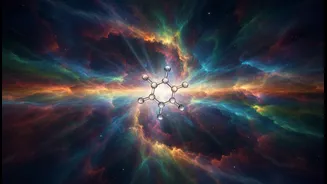
Astronomers have detected a sugar molecule called erythrulose for the first time in the interstellar medium. Using powerful radio telescopes in Spain, an international team scanned a vast, dense cloud of gas and dust known as G+0.693-0.027, located near
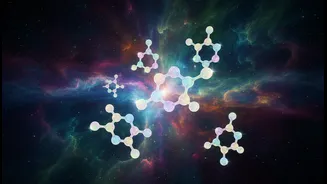
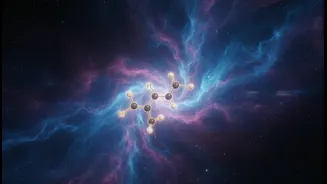
the center of the Milky Way. By analyzing the faint radio signals emitted by molecules in this region, they identified the distinct spectral fingerprint of erythrulose, a four-carbon sugar. This molecule, which on Earth is found in raspberries and used in cosmetics, is the first true sugar and the largest non-cyclic molecule ever identified between the stars.
What Makes This Sugar So Special?
Sugars are fundamental to life as we know it, serving as energy sources and forming the structural backbone of DNA and RNA. Erythrulose is not just any sugar; it's considered a key prebiotic molecule. This means it is a plausible stepping stone on the chemical pathway to life. Scientists have long theorized that before the more complex five-carbon sugar ribose (found in RNA) became dominant, simpler systems may have existed. In water, erythrulose can convert into other four-carbon sugars like threose, which can form a simpler alternative to RNA, suggesting it could have played a crucial role in the earliest stages of life's chemistry.
Solving a Prebiotic Puzzle
One of the great mysteries in origin-of-life research is the "sugar problem." While lab experiments simulating early Earth conditions have struggled to produce sugars in significant amounts, we know they became abundant. This discovery offers a compelling solution: perhaps Earth didn't have to make all its own sugars. Previous findings of sugars in meteorites and on asteroids like Bennu hinted that these ingredients could come from space. Detecting erythrulose in a molecular cloud—a stellar nursery where stars and planets are born—pushes the origin of this chemistry back even further, showing that these essential molecules exist before planets even form.
Shifting Everyday Scientific Decisions
This discovery directly influences the "everyday decisions" of the scientific community. For astrobiologists, it validates the theory that the cosmos is a vast chemical laboratory capable of producing life's precursors. It provides a new, confirmed target for astronomers to search for in other star-forming regions across the galaxy. For chemists, it helps narrow down the most plausible pathways for abiogenesis—the process by which life arises from non-living matter—guiding future laboratory experiments. This finding encourages researchers to look for even more complex sugars, like ribose itself, bringing us closer to understanding if the recipe for life is a universal phenomenon.
A Cosmic Delivery System
The existence of erythrulose in interstellar clouds suggests a cosmic delivery system. Scientists believe these molecules form on the surfaces of icy dust grains. These grains then clump together to form asteroids and comets. It is estimated that millions of tonnes of erythrulose could have been delivered to a young Earth during the Late Heavy Bombardment, a period of intense comet and asteroid impacts about 4 billion years ago. This cosmic rain would have seeded the planet's primordial oceans with the raw materials needed to kickstart the chemical reactions that ultimately led to life.