



The Ultimate Cosmic Monopoly
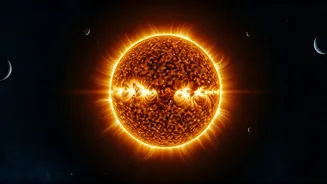
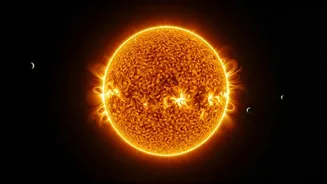
The headline is dramatic, but it’s scientifically sound. When we talk about the Sun’s dominance, we are really talking about its mass. The most precise measurements show that the Sun accounts for a staggering 99.86% of the total mass of our entire solar
system. [1, 2, 6, 17] This means that all the planets—Jupiter, Saturn, Earth, and all the others—plus every moon, asteroid, and comet combined, make up a mere 0.14% of the system’s total substance. [6] To put that in perspective, imagine the entire solar system’s mass is a single Rs 1,000 note. The Sun would be worth Rs 998.60, while everything else, from the gas giants to the dust between planets, would be worth just Rs 1.40. This isn't just a fun fact; this incredible disparity in mass is the single most important feature of our cosmic neighbourhood, defining how everything within it behaves.
Gravity’s Undisputed King
Mass and gravity are inextricably linked. The more massive an object is, the stronger its gravitational pull. [11] Because the Sun holds 99.86% of the mass, it exerts a gravitational force so dominant that it holds the entire system together. [7, 11] Every planet, asteroid, and comet is locked in an orbit, perpetually falling towards the Sun but moving just fast enough sideways to keep missing. [18] This delicate balance, governed by the Sun’s immense gravity, creates the orderly, predictable solar system we know. Without the Sun’s gravitational anchor, the planets would simply drift off into the cold, dark void of interstellar space. [11] Even the shape of the solar system, which is largely a flat plane, is a result of the Sun’s gravity collapsing the initial cloud of gas and dust from which everything formed. [11]
A Star’s Fiery Ingredients
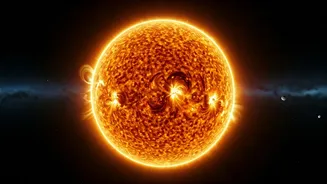
So, what is this celestial behemoth actually made of? Unlike our rocky Earth, the Sun is an enormous ball of superheated gas, so hot that it exists in a state called plasma. [1, 8] Its composition is surprisingly simple: about 73-75% of its mass is hydrogen, and around 25% is helium. [1, 8, 10] All other elements, which astronomers collectively call 'metals', make up less than 2% of the Sun. [1, 10] The Sun’s immense energy comes from a process in its core called nuclear fusion. [3] The core's temperature reaches an unimaginable 15 million degrees Celsius, and the pressure is immense. [3, 7] In these extreme conditions, hydrogen atoms are fused together to create helium, releasing a tremendous amount of energy in the process. This outward push of energy perfectly balances the inward pull of the Sun's own gravity, keeping it stable.
What About the Other 0.14 Percent?
If the Sun is 99.86% of the mass, the remaining sliver must be insignificant, right? Not quite. Of that tiny 0.14%, the planet Jupiter accounts for the majority. [6] In fact, Jupiter is more than twice as massive as all the other planets in the solar system combined. [2] This makes it the second most massive object in our system, yet it is still only about 1/1000th the mass of the Sun. [16] After Jupiter, the other gas giants—Saturn, Uranus, and Neptune—take up most of what’s left. [6] Our own planet, Earth, along with Mars, Venus, and Mercury, represents a minuscule fraction of that remaining fraction. [6] Earth’s mass is about 333,000 times smaller than the Sun’s. [3, 5] This hierarchy shows that while the Sun is the undisputed ruler, Jupiter is the solar system's powerful second-in-command.