






Reading the Skies of Alien Worlds
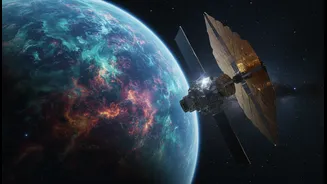
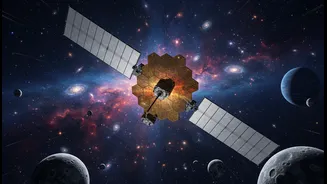
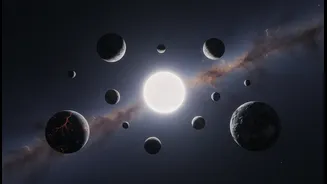
Since its launch, the James Webb Space Telescope has revolutionised our ability to peer into the atmospheres of exoplanets—planets orbiting stars other than our Sun. One of its most groundbreaking capabilities is analysing the composition of these alien
skies. It does this using spectroscopy, a technique that involves capturing the light from a host star as it filters through a planet's atmosphere. Different molecules and cloud particles absorb specific wavelengths of light, creating a unique chemical fingerprint. This allows scientists to identify elements like water, methane, and carbon dioxide from light-years away, turning these distant worlds from simple points of light into places with discernible chemistry and weather.
Clouds of Rock and Water Ice
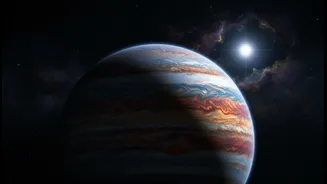
Not all clouds are made of water. On Earth, we are used to water vapour condensing into clouds, but on other worlds, the ingredients can be far more exotic. Webb's observations have revealed planets with truly alien weather. For instance, on the exoplanet VHS 1256 b, the telescope detected clouds made of silicates—essentially tiny grains of sand or rock. On this scorching world, temperatures in the upper atmosphere reach around 830 degrees Celsius, creating turbulent, gritty skies where it effectively rains hot sand. In a completely different environment, Webb found evidence of water-ice clouds on the cold, Jupiter-like planet Epsilon Indi Ab, which were unexpectedly hiding the ammonia scientists predicted they would find. These discoveries challenge existing models of planetary atmospheres and show the incredible diversity of weather across the galaxy.
A Daily Cycle of Disappearing Clouds
One of the most dramatic discoveries involves the daily weather cycle on WASP-94A b, a type of planet known as a 'Hot Jupiter'. Observations in May 2026 revealed that this planet experiences a bizarre daily routine where clouds made of rock-like minerals form every morning and then completely vanish by the evening. As the planet rotates, its morning side—where cooler air from the night side flows toward the intensely hot day side—sees these mineral clouds build up. As the day progresses and temperatures soar, the clouds dissipate, leaving clear skies by evening. This observation of a cloud cycling between a condensed and vaporised state provides an unprecedented look at dynamic weather patterns on a distant world and helps scientists refine their understanding of atmospheric physics under extreme conditions.
The Ultimate Clue: A Search for Life
Beyond fascinating weather, these atmospheric studies are a crucial part of the search for life beyond Earth. On some planets, like the much-discussed K2-18 b, Webb has detected molecules that could be potential biosignatures—clues that hint at biological processes. The telescope found methane and carbon dioxide, and, more tantalisingly, a tentative signal of dimethyl sulfide (DMS). On Earth, DMS is overwhelmingly produced by marine life, like phytoplankton. While the DMS signal on K2-18 b is still debated and requires more data to confirm, it represents one of the strongest hints yet of possible biological activity on an exoplanet. Even if these specific signals turn out to have non-biological origins, the ability to detect such molecules is a monumental step forward, proving that Webb can hunt for the chemical clues that may one day lead to the discovery of life elsewhere.