





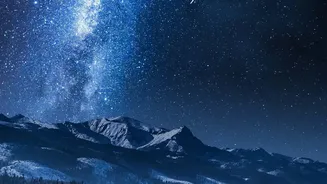
A Gift from Halley's Comet
The Orionid meteor shower is one of two annual showers created by the debris of Halley's Comet, the most famous comet in our solar system. As Earth crosses its orbital path, tiny particles, many no bigger than a grain of sand, slam into our atmosphere
at incredible speeds—around 66 kilometres per second. This intense velocity is why Orionids are known for being exceptionally bright and fast. They often leave behind persistent, glowing trails of ionised gas that can hang in the sky for several seconds after the meteor has vanished, and some can even explode as brilliant fireballs.
Mark Your 2026 Calendar
The peak of the 2026 Orionids is expected on the night of October 21-22. While the shower is active from early October to early November, your best chance to see the highest number of meteors will be during these peak nights. The ideal time to watch is in the hours after midnight, leading up to dawn. This is when the shower's radiant—the point in the constellation Orion from which the meteors appear to originate—is highest in the sky, maximising your chances of a good show.
The Challenge: A Bright Moon
Unlike some years, 2026 presents a specific challenge for skywatchers: a bright waxing gibbous moon, which will be about 77-80% illuminated during the peak. This natural light pollution will wash out many of the fainter meteors for most of the night. However, there is a crucial window of opportunity. The moon will set a few hours before dawn, leaving the sky perfectly dark for the prime viewing time just before sunrise. This makes finding a location with minimal artificial light pollution more important than ever to take advantage of that dark, pre-dawn window.
The Science of Seeing in the Dark
Our eyes need time to adjust to darkness. It takes about 20 to 30 minutes for your pupils to fully dilate and for your eyes to switch to using their rod cells, which are responsible for night vision. Even a brief glance at a bright phone screen or a passing headlight can reset this process. In a truly dark location, your eyes can become sensitive enough to spot the fainter, more numerous meteors that constitute the bulk of any shower. Under city or suburban skies, this light pollution creates a permanent 'skyglow' that never allows your eyes to fully adapt, reducing a potential spectacle of 20 meteors per hour to just a few, if any.
Your Guide to Finding Darkness
To truly experience the Orionids, you must escape city lights. For residents of India, this can mean heading to designated dark sky reserves or remote areas. Hanle in Ladakh is India's first official Dark Sky Reserve, offering some of the clearest skies in the world. Other excellent locations include Spiti Valley, the Rann of Kutch, and high-altitude spots in the Western Ghats like Coorg or Valparai. Even driving an hour or two away from a major urban centre can make a significant difference. Use online light pollution maps to find a 'green' or 'blue' zone near you. Once there, give your eyes at least 20 minutes to adapt, and avoid all sources of white light.