




Seeing the Invisible: What is Infrared?
To understand Webb's superpower, we first need to appreciate that visible light is just a tiny fraction of the light that fills the universe. Beyond the red light our eyes can see lies the infrared spectrum. It's the same kind of energy you feel as heat
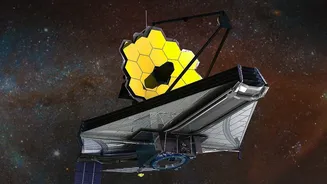
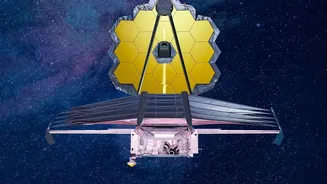
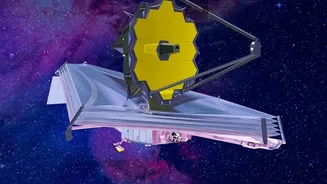
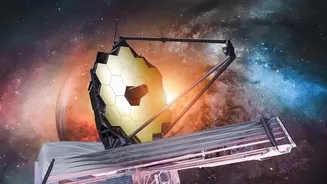
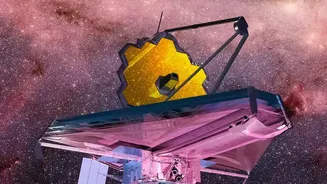
from a fire or the sun. While our eyes can't detect it, infrared light carries a treasure trove of information. The James Webb Space Telescope is specifically designed to be a master of this domain, observing the cosmos in a range from near-infrared to mid-infrared light. This is crucial because many of the most interesting cosmic events, from the birth of stars to the glow of distant planets, are brightest and most detailed when viewed in infrared.
The Challenge of Starlight
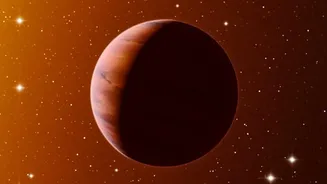
Studying the atmosphere of an exoplanet—a planet orbiting another star—is an immense challenge. These planets are incredibly far away and faint. Worse, they are almost completely washed out by the brilliant light of their parent stars. Directly imaging the atmosphere is usually impossible. This is where scientists employ a clever technique called transit spectroscopy. When an exoplanet passes, or 'transits', in front of its star from our point of view, a tiny fraction of the starlight filters through the planet's atmosphere before reaching Webb's mirrors. For a brief moment, the atmosphere leaves its fingerprints on that light, and that's the moment Webb is built to capture.
Spectroscopy: De-coding the Light
Webb’s primary tools for this task are not cameras in the traditional sense, but spectrographs. These instruments, like NIRSpec and NIRISS, take the captured starlight and spread it out into its constituent wavelengths, much like a prism creates a rainbow. But instead of just a pretty smear of colours, this spectrum holds the key to the exoplanet’s atmospheric chemistry. As the starlight passes through the alien atmosphere, different gas molecules absorb very specific wavelengths of light. Water vapour, methane, carbon dioxide, and other compounds each have a unique 'absorption' signature—a pattern of missing light in the spectrum that acts like a chemical fingerprint.
Infrared: The Perfect Wavelength
So why is infrared the gold standard for this work? The answer lies in basic physics. The molecules that make up planetary atmospheres—especially the building blocks for life like water, methane, and carbon dioxide—are particularly active in the infrared part of the spectrum. They absorb infrared light much more prominently than they do visible light, creating stronger, more obvious fingerprints for Webb to detect. This makes Webb's infrared sensitivity absolutely essential for finding these key ingredients. Furthermore, infrared light is less scattered by the cosmic dust that often fills the space between stars, giving Webb a clearer view through otherwise hazy regions.
Putting It All Together
By combining the transit method with high-precision infrared spectroscopy, Webb achieves its unprecedented views. The process works like this: astronomers measure the star’s light spectrum when the planet is beside it, then measure it again as the planet transits in front. By subtracting the second measurement from the first, they can isolate the tiny amount of light that was absorbed by the planet’s atmosphere alone. The resulting transmission spectrum reveals which gases are present and in what quantities. This allows scientists to determine if a rocky world has an atmosphere at all, what a gas giant is made of, and even search for the chemical signs that might suggest a planet could be habitable.