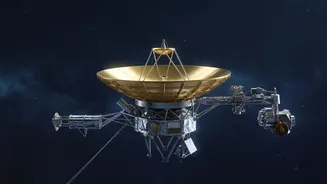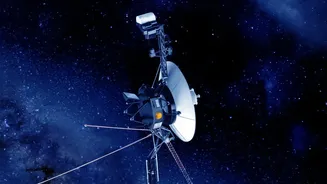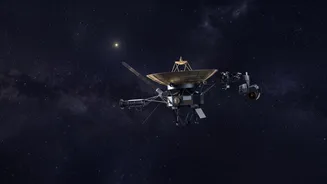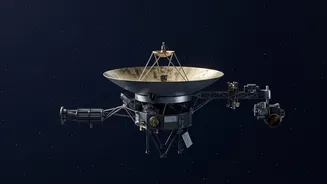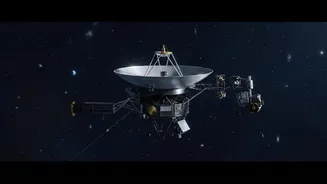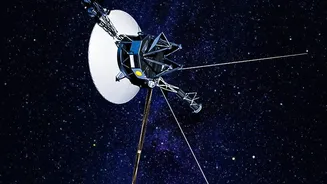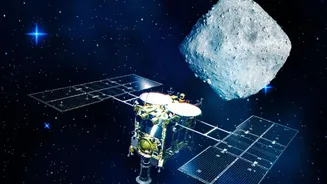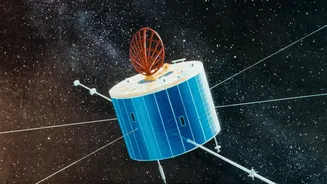


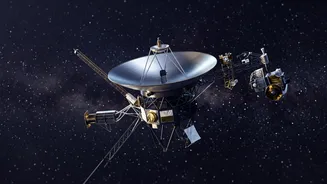
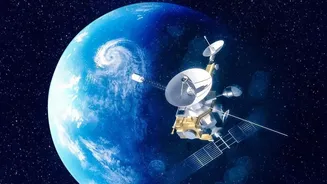
On November 18, a machine launched when Jimmy Carter was president will achieve something unprecedented. After 49 years of silent travel, Voyager 1 will be a full light-day from Earth, a testament to human curiosity and 1970s engineering.
A Milestone Measured in Light
Imagine sending
a message and having to wait two full days for a reply. That will be the new reality for NASA's engineers communicating with Voyager 1 starting November 18, 2026. On that day, the spacecraft will be one light-day, or approximately 25.9 billion kilometres, from our planet. This means its radio signals, travelling at the fastest speed possible, will take a full 24 hours to reach Earth. The milestone isn't a physical boundary, but a profound marker of distance. A light-day is about 173 times the distance between the Earth and the Sun. For Voyager 1, which cruises at nearly 61,000 kilometres per hour, the journey to this point will have taken 49 years, two months, and eleven days.
An Unexpected Journey
Voyager 1 was never designed to last this long. Launched on September 5, 1977—16 days after its twin, Voyager 2—its primary mission was a five-year 'Grand Tour' of the outer planets. Even its launch was nearly a failure, as its Titan IIIE rocket stage shut down early. But the probe persevered, taking a faster, more direct route to Jupiter and Saturn than its twin. Its flyby of Jupiter in 1979 revolutionized our understanding of the gas giant, revealing its faint ring system and, most spectacularly, active volcanoes on its moon Io—the first ever seen beyond Earth. In 1980, it studied Saturn's complex rings and moons, including a close pass of Titan that confirmed its dense, nitrogen-rich atmosphere. That flyby redirected its course, flinging it up and out of the plane of the solar system and onto its current path into the cosmos.
Into the Great Unknown
After its planetary mission ended, Voyager 1 kept going. In February 1990, it turned its camera around one last time to take the iconic 'Pale Blue Dot' photo, showing Earth as a tiny speck from six billion kilometres away. It then became the most distant human-made object in 1998, overtaking the Pioneer 10 probe. The next major landmark came in August 2012, when Voyager 1 crossed the heliopause—the boundary where the Sun's stream of charged particles gives way to the interstellar medium. It officially entered interstellar space, becoming humanity's first emissary to the stars. It now drifts through this uncharted territory, measuring magnetic fields and plasma waves from a place no other probe has ever reached.
Still Phoning Home After All These Years
Keeping a nearly 50rd year old spacecraft alive is a constant challenge. Its plutonium power source decays steadily, losing about four watts of power each year from its initial 470 watts. To conserve energy, engineers have been methodically shutting down non_essential systems and heaters. Recently, a power_saving operation nicknamed the 'Big Bang' re_routed power to extend the life of its remaining science instruments. The mission has also overcome recent scares, including a 48_hour communication loss in October 2026 that mysteriously resolved itself. Engineers discovered the probe had automatically switched to a backup set of thrusters, a pre_programmed safety measure. These moments highlight the incredible resilience of a machine built with technology less powerful than a modern smartphone.
Humanity's Silent Ambassador
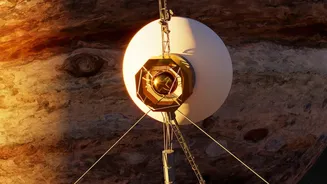
Voyager $^$ carries with it a message in a bottle: the Golden Record. This gold_plated copper disk contains sounds and images selected to portray the diversity of life and culture on Earth. Curated by a committee led by Carl Sagan, it includes greetings in $^$55 languages, music from Bach to Chuck Berry, and $^$1$^$5 images of our world. It is a time capsule, a greeting to any civilization that might one day find it. While the chances are infinitesimally small, the record ensures that Voyager $^$s legacy is more than just data. For now, it continues its silent journey toward a faint star named AC +79 $^$3888$, which it will pass in about $^$40$,$^$000 years. Its instruments may fall silent in the $^$2030s as its power finally fades$, but the probe itself will wander the Milky Way for eons$, a testament to a species that once looked up at the stars and decided to go.