



The Lure of an Alien Ocean
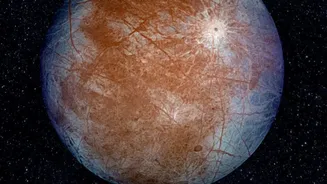
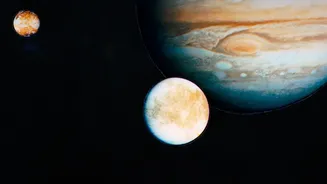
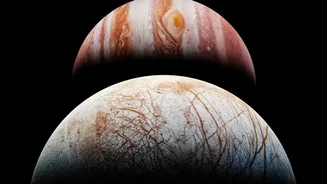
For decades, Europa has been a prime candidate in the search for extraterrestrial life. Slightly smaller than Earth's moon, it is one of the smoothest objects in the solar system, suggesting its surface is constantly being renewed. Scientists believe
this is because of a global saltwater ocean lurking miles beneath the ice. The strongest evidence came from NASA's Galileo mission in the 1990s, which detected a distorted magnetic field around Europa. This suggests the presence of a global, electrically conductive fluid—like a salty ocean. The constant gravitational tug-of-war from Jupiter and its other moons generates heat through tidal flexing, a process that likely keeps Europa's interior warm and its hidden ocean liquid. This same process could fuel hydrothermal vents on the seafloor, similar to those on Earth that support entire ecosystems without sunlight.
A Mission Years in the Making
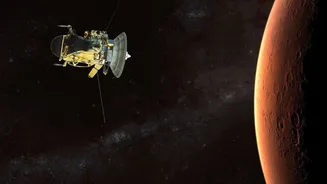
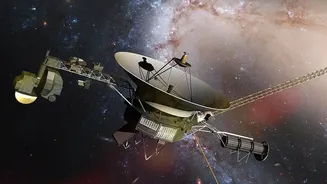
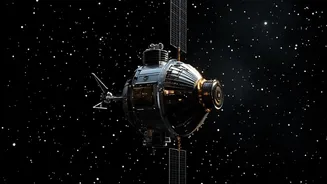
Launched on October 14, 2024, aboard a SpaceX Falcon Heavy rocket, the Europa Clipper is NASA's largest interplanetary spacecraft to date. Its 1.8-billion-mile journey to the Jupiter system is a long and complex one, scheduled to last five and a half years. To build up enough speed, the spacecraft is performing several gravity assists. It already flew by Mars in March 2025 and is scheduled for a final slingshot past Earth in December 2026. The spacecraft is expected to arrive and enter orbit around Jupiter in April 2030. Instead of orbiting Europa directly—which would expose it to Jupiter's punishing radiation—Clipper will make nearly 50 close, elliptical flybys of the moon over four years, some as low as 16 miles (25 kilometers) above the surface. This strategy allows for detailed investigation while protecting its sensitive electronics, which are housed within a thick-walled titanium and aluminum vault.
The Toolkit for Discovery
To peer beneath the ice and taste the environment, Europa Clipper carries a sophisticated suite of nine scientific instruments. The Europa Imaging System (EIS) will capture high-resolution images to map the surface, while an ice-penetrating radar called REASON will probe the ice shell's thickness and search for pockets of water. Spectrometers like MISE and Europa-UVS will analyze the chemical composition of the surface and thin atmosphere, looking for key compounds like salts and organics. A thermal imager, E-THEMIS, will hunt for warmer spots where liquid water might be near the surface or has recently erupted. The mission will also use a magnetometer (ECM) and a plasma instrument (PIMS) to confirm the ocean's existence and measure its depth and salinity by studying the moon's magnetic field. Finally, dust and gas analyzers will directly sample particles in space, hoping to catch material from any water plumes that may be erupting from the ocean below.
Searching for Signs, Not Life Itself
A key distinction of the Europa Clipper mission is that it's not designed to find life itself, but to determine if the conditions for life exist. Scientists refer to this as assessing the moon's "habitability." This involves confirming the three essential ingredients for life as we know it: liquid water, essential chemical elements, and a source of energy. Europa appears to have all three. The mission will confirm the water ocean, inventory the chemical makeup of the surface and any plumes, and study the energy supplied by tidal flexing. By understanding the thickness of the ice shell, the saltiness of the water, and the chemistry available, scientists can build a complete picture of this ocean world. This will help determine if it's a place where life could realistically begin and survive, paving the way for a potential future lander mission that could search for direct evidence of organisms.