



The Ultimate Off-Grid Problem
On Earth, we take the Global Positioning System (GPS) for granted. This invisible network of satellites makes everything from food delivery to international shipping possible by providing precise location data. But building a similar 30-satellite constellation
just for the Moon is a colossal expense and logistical nightmare. The GPS signals we use on Earth are also incredibly weak by the time they reach lunar distances, making them unreliable for the precision needed to construct habitats and infrastructure. This creates a fundamental challenge for the Artemis program and commercial partners aiming to establish a permanent human presence on the Moon: before you can build anything, your robotic workforce needs to know where it is, where to go, and how to get there safely and efficiently.
Looking Inward: Navigating by Feel
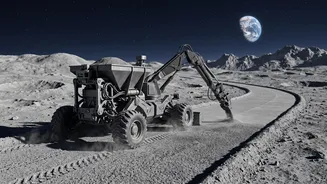
The oldest solution to navigating without external signals is 'dead reckoning'. This technique was used by sailors for centuries and even by the Apollo-era Lunar Roving Vehicle. Modern robots use a high-tech version of this called an Inertial Navigation System (INS). These systems use gyroscopes and accelerometers to track every turn, bump, and movement from a known starting point. The problem is that tiny errors accumulate over time, an issue known as 'drift'. A robot might think it has traveled 100 meters in a straight line, but in reality, it may have drifted several meters to the side. Over a long construction job, this inaccuracy can be disastrous. While an INS is a crucial part of the puzzle, it can't be the only solution.
Seeing the Way: Visual Landmark Recognition
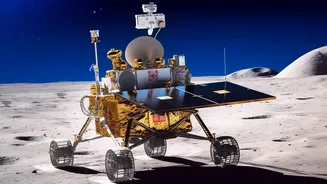
A more advanced method involves giving the robots 'eyes'. Using a technique called Visual Simultaneous Localization and Mapping (VSLAM), a rover uses its cameras to build a 3D map of its surroundings as it moves. It identifies unique features—a specific crater rim, a prominent boulder, a patch of dark regolith—and uses them as landmarks. By constantly referencing these landmarks, the robot can determine its position within the map it's creating. This is a huge leap forward, as it allows a robot to self-correct its position and navigate complex terrain without needing external signals. It's like leaving a trail of digital breadcrumbs that the robot can use to retrace its steps or plan new routes with confidence.
Strength in Numbers: Cooperative Navigation
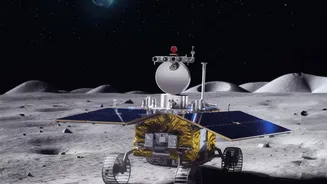
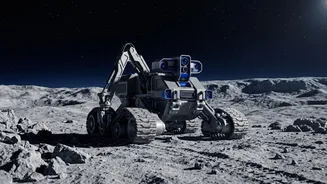
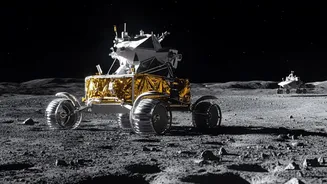
Perhaps the most exciting frontier in lunar navigation is getting robots to work together. NASA's Cooperative Autonomous Distributed Robotic Exploration (CADRE) mission, scheduled to land on the Moon in 2026, is a perfect example. It involves a team of three small, suitcase-sized rovers that will explore the lunar surface autonomously. They will communicate with each other over a local mesh network, sharing their position data and sensor readings. If one rover has a clear view of a landmark and another doesn't, they can combine their information to pinpoint their locations with greater accuracy than any single rover could alone. One rover will act as a 'leader', delegating tasks to the others to create 3D maps of the terrain. This 'swarm' approach not only improves navigational accuracy but also builds in redundancy; if one robot goes down, the team can reconfigure and continue the mission.
Creating a Local Network
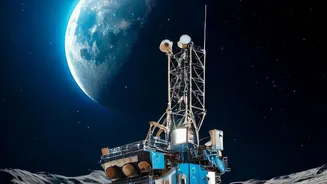
While a full lunar GPS is a distant goal, space agencies are working on intermediate solutions. NASA and the European Space Agency (ESA) are developing plans for 'LunaNet', a framework that would provide both communication and navigation services for future lunar missions. This could involve a small constellation of satellites in lunar orbit and surface beacons placed at key locations, like a landing zone or a future base. These beacons would act like lighthouses, broadcasting signals that rovers could use to triangulate their position with high accuracy. This hybrid approach combines the autonomy of individual robots with the reliability of a dedicated, albeit limited, infrastructure, providing the robust navigation needed for the complex task of building a home on another world.