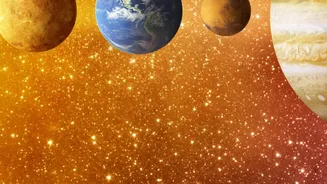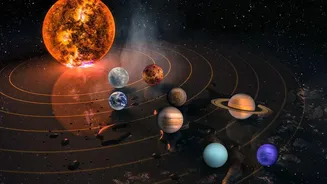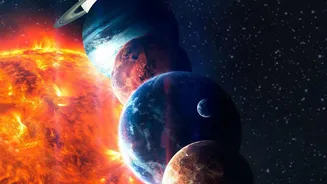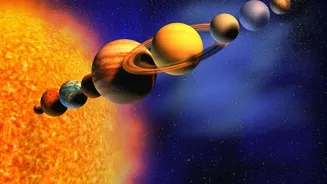


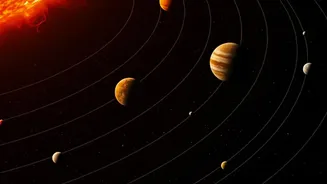
We tend to imagine our solar system as a perfectly predictable cosmic clock. But new research peering into the far future suggests that even the mighty giant planets may face a chaotic, unstable end billions of years from now.
A Clockwork Cosmos?
For centuries, we have looked
to the heavens and seen order. The planets in our solar system move in steady, predictable orbits, a celestial dance governed by gravity. This perceived stability has been a cornerstone of astronomy, with thinkers from Newton to the present day pondering whether this elegant arrangement could last forever. While for any human timescale the answer is a resounding yes, when astronomers talk about the 'far future', they are dealing with immense stretches of time—billions, or even trillions, of years. On these cosmic timescales, even tiny, seemingly insignificant gravitational nudges between planets can accumulate, introducing an element of chaos into the system.
When Our Sun Changes
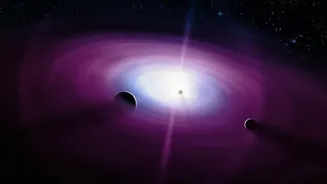
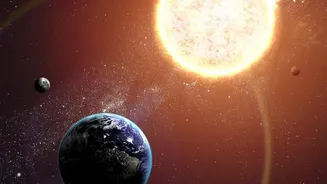
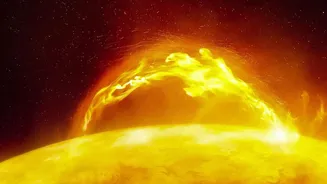
The ultimate driver of change in our solar system will be the Sun itself. In about five billion years, our star will exhaust the hydrogen fuel in its core and swell into a red giant, likely consuming Mercury, Venus, and possibly Earth. After this phase, it will collapse into a dense, dim remnant called a white dwarf, having shed about half its original mass. It was long thought that this mass loss would be a smooth, gentle process. In that scenario, the outer planets—Jupiter, Saturn, Uranus, and Neptune—would simply drift into wider, but still stable, orbits. Previous models suggested this new configuration could remain stable for up to 100 billion years or more.
A More Violent End
However, a recent study published in The Astrophysical Journal Letters proposes a more dramatic and chaotic future. A team of researchers, using hundreds of advanced computer simulations, re-examined what happens when the Sun dies. Their new model assumes the Sun will not lose mass smoothly. Instead, it will likely happen through uneven, violent ejections, delivering small but significant 'kicks' to the dying star. These random jolts, repeated over time, would slowly disrupt the delicate gravitational balance holding the outer planets in their orbits.
The Giants' Unruly Dance
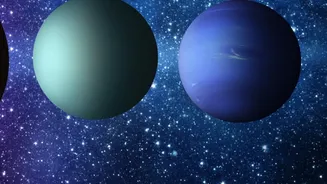
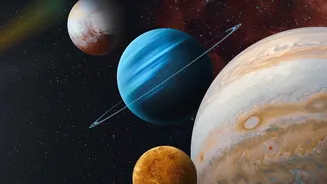
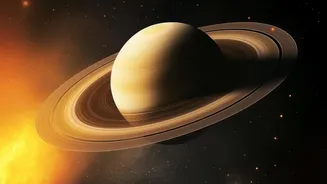
The simulations show that this uneven process significantly shortens the lifespan of the outer solar system's stability. Instead of trillions of years, the giant planets could be thrown into disarray within just one billion years after the Sun becomes a white dwarf. The potential outcomes are dramatic. The simulations showed that in many scenarios, the planets' orbits become unstable, crossing paths with one another. In some virtual futures, Saturn was ejected from the solar system entirely, while in others, Uranus and Neptune actually swapped their positions in orbit. This instability is triggered by the planets' gravitational pulls on each other becoming relatively stronger as the Sun's own gravity weakens.
Why We Study a Future We Won't See
This research is not a cause for alarm; humanity's timeline is a mere blip compared to these cosmic events. The true value of these studies is in helping us understand the fundamental principles of how planetary systems form, evolve, and die. By refining models of our own solar system's future, scientists can better interpret what they see in distant star systems. Observations of other stars, particularly white dwarfs, often show evidence of planetary debris, and these new models help explain how such a chaotic breakdown could occur. It provides a crucial piece of the puzzle for understanding the life cycle of planets throughout the universe.