


The Fiery Arrival
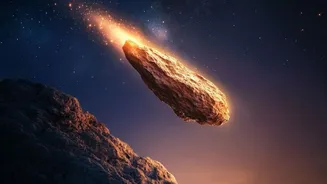
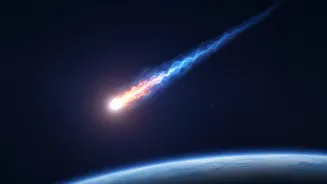
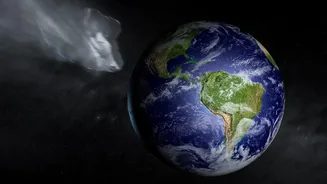
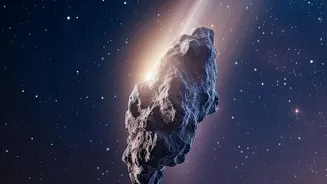
When a piece of rock or dust from space, called a meteoroid, hits Earth’s atmosphere at incredible speeds, it becomes a meteor. This isn't just one type of event; the brightness tells a story. A small, sand-grain-sized particle creates a brief 'shooting
star', while a larger, golf-ball-sized rock produces a brilliant fireball that can light up the night sky. To capture these events, scientists use sophisticated camera networks, like NASA's All Sky Fireball Network and the global Desert Fireball Network. These systems use multiple cameras with overlapping views to photograph the meteor from different angles. This triangulation allows them to calculate the meteor's trajectory, height, and, most importantly, its speed as it streaks through the air.
Speed Is the First Big Clue
A meteor's velocity is one of the most critical pieces of the puzzle. Objects in our solar system don't all travel at the same speed. Their orbital velocity depends on their distance from the Sun. Generally, slower-moving meteors, which enter our atmosphere at speeds around 11 to 30 kilometres per second, are often associated with the asteroid belt located between Mars and Jupiter. These are fragments chipped off asteroids. In contrast, much faster meteors, sometimes exceeding 70 kilometres per second, often originate from comets. These comets have highly elongated orbits that swing them from the outer reaches of the solar system, so debris they shed is moving much faster relative to Earth when it intersects our path.
Reversing the Journey
Once astronomers have the meteor's speed and its precise path through the atmosphere, they can begin the process of 'running the clock backwards'. Using powerful computer models, they account for the effects of Earth's gravity, its rotation, and the atmospheric drag that slowed the object down. The goal is to calculate the meteoroid’s velocity and direction before it hit the atmosphere. This gives them the object's pre-impact orbit around the Sun. For example, if a meteor is seen by cameras in two different locations, the two lines of sight can be used to define a plane, helping to reconstruct the path with high precision. This intricate process essentially erases the final, fiery moments of the journey to reveal its original cosmic highway.
Finding a Cosmic Parent
With a pre-entry orbit calculated, the final step is to play cosmic matchmaker. Astronomers compare the meteoroid's calculated orbit with the known orbits of thousands of comets and asteroids. Often, the orbits align perfectly with a known 'meteoroid stream'—a trail of dusty debris left behind by a specific comet on its repeated trips around the Sun. This is how we know the famous Perseid meteor shower comes from Comet Swift-Tuttle and the Leonids come from Comet Tempel-Tuttle. If the orbit doesn't match a known shower, it might be a 'sporadic' meteor, possibly a lone fragment from the asteroid belt. By linking the meteor to a parent body, scientists can effectively get a sample of that object without the billion-dollar price tag of a space mission.