

Listening to the Cosmos
Imagine dropping a stone into a still pond. The ripples that spread across the water are similar to gravitational waves. These are invisible ripples in the very fabric of space and time, created by cataclysmic events like the collision of black holes.
First predicted by Albert Einstein, their existence was only confirmed in 2015. This discovery, made by the Laser Interferometer Gravitational-Wave Observatory (LIGO), gave humanity a completely new sense with which to perceive the cosmos. Instead of just seeing the universe, we can now 'hear' the vibrations from its most extreme occurrences. These waves carry information about their powerful sources, offering insights that are impossible to obtain through traditional telescopes.
The Mysterious Middle Child
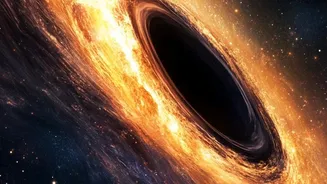
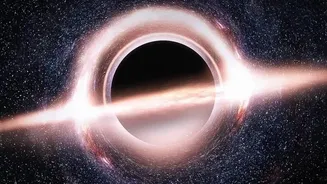
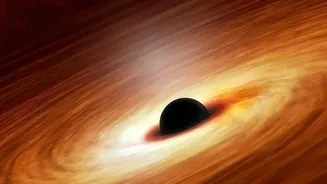
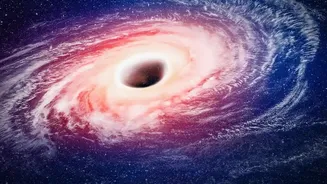
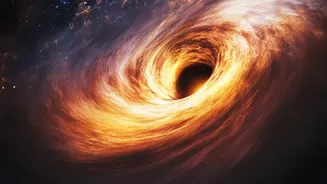
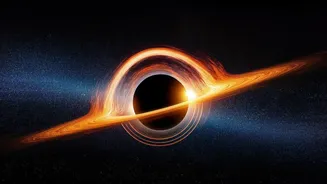
When it comes to black holes, astronomers have long been familiar with two main categories. There are stellar-mass black holes, typically 5 to 50 times the mass of our sun, which form when a single massive star collapses. Then there are the supermassive black holes, giants that are millions or even billions of times our sun's mass and sit at the heart of most galaxies, including our own Milky Way. For years, there was a glaring gap between these two: the intermediate-mass black hole (IMBH), with a mass of roughly 100 to 100,000 times that of the sun. Finding them has been a major challenge, earning them the nickname of the 'missing link' in black hole evolution.
A Collision of Cosmic Giants
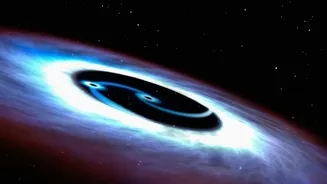
The latest breakthroughs in gravitational wave astronomy are finally bringing this missing link into focus. Scientists analysing data from the global network of detectors, including LIGO and its European counterpart Virgo, have identified signals from the mergers of IMBHs. When two of these rare objects, likely orbiting each other in the crowded centre of a galaxy, finally collide, they create a single, more massive black hole. This cosmic smash-up is so violent that it sends a powerful burst of gravitational waves hurtling across the universe. By detecting these faint ripples here on Earth, scientists can reconstruct the event, calculating the masses of the original black holes and confirming they belong to the elusive intermediate class.
The Seeds of a Supermassive Future
So why is finding these mid-sized black holes so important? They may hold the key to understanding one of the biggest puzzles in cosmology: how do supermassive black holes get so big? One leading theory is that they grow through a process called hierarchical merging. This idea suggests that smaller black holes merge over and over, gradually building up mass. The mergers of IMBHs are a crucial piece of this puzzle. Each detected merger acts like a fossil record, showing how these building blocks can combine. Scientists believe that these events, which were more frequent in the early universe, could be the 'seeds' from which the supermassive black holes that anchor entire galaxies grew. In essence, by listening to these collisions, we are watching galaxy formation in action.
India's Front-Row Seat
India is poised to become a world leader in this exciting field. Construction is underway for the LIGO-India observatory in the Hingoli district of Maharashtra. This facility, a joint Indo-US collaboration, will house a detector identical to the two LIGO instruments in the United States. When it becomes operational around 2030, it will be the fifth such major observatory in the world, joining the network with LIGO, Virgo in Italy, and KAGRA in Japan. Adding LIGO-India to the network will dramatically improve scientists' ability to pinpoint the exact location of gravitational wave sources in the sky. This precision is crucial for allowing traditional telescopes to quickly look at the event's aftermath, ushering in an era of 'multi-messenger astronomy' and securing India's place at the forefront of cosmic discovery.