
The Lure of the Lunar South Pole
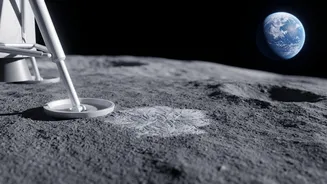
For decades, the Moon was thought to be completely dry. But recent missions, including India's Chandrayaan-1, confirmed the presence of water ice, especially at the lunar South Pole. This region is home to "permanently shadowed regions" (PSRs) — deep
craters whose floors haven't seen sunlight in billions of years. These incredibly cold spots have acted as cosmic cold traps, preserving ice that could be a game-changer for space exploration. NASA's Artemis program plans to establish a base camp precisely here, not just for the scientific value, but because this ice is the key to making a long-term human presence on the Moon sustainable. Living off the land, or "in-situ resource utilization" (ISRU), is the central pillar of this strategy, drastically reducing the need to launch heavy water and oxygen supplies from Earth.
Prospecting and Mining in the Dark
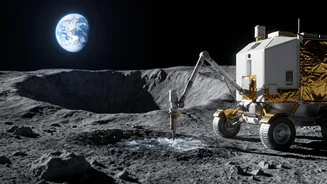
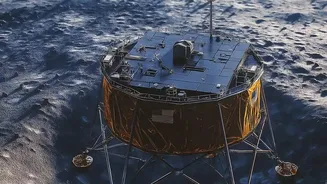
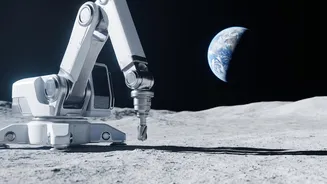
Before astronauts can use this water, they need to know exactly where it is, how much is there, and how to get it. This is the job of robotic prospectors. NASA is developing robotic missions to scout the area ahead of human arrival. A key part of this effort was the planned VIPER (Volatiles Investigating Polar Exploration Rover) mission, a golf-cart-sized robot designed to map the concentration of water ice. Although the specific VIPER mission was cancelled, the objective remains a priority, and other commercial landers and rovers are being developed to carry out this crucial resource mapping. Future missions will use drills, like the TRIDENT drill, to dig up the icy regolith (lunar soil) and analyze it on the spot with instruments like mass spectrometers. These robots will have to navigate treacherous, dark terrain at extreme cold temperatures to locate the most promising ice deposits for future extraction.
From Ice to Air and Water
Once the icy soil is located and excavated by robotic miners, the next step is to extract the water. Several methods are being tested, but the leading concept involves heating the excavated regolith in a contained reactor. This process, called sublimation, turns the solid ice directly into water vapour, leaving the soil behind. The water vapour is then collected and re-frozen in a cold trap, producing pure, solid ice. This ice can then be melted for drinking water after purification. To create breathable air, the water undergoes a process called electrolysis. An electric current is passed through the water (H₂O), splitting the molecules into their component parts: breathable oxygen (O₂) and hydrogen (H₂). This technology is fundamental; the same process is used on the International Space Station to generate oxygen for the crew, but on the Moon, it will rely on local resources for the first time.
Powering a Lunar Outpost
All of these processes—mining, heating, and electrolysis—require a significant and continuous source of power, which is a major challenge in a place known for its extreme darkness. The solution lies just beyond the shadows. While the floors of the PSR craters are in perpetual dark, their rims receive near-constant sunlight. The plan for the Artemis base camp involves placing large solar arrays on these crater rims to soak up solar energy. This electricity will power the outpost's habitats and life support systems, and crucially, provide the energy needed to drive the ISRU technology that turns ice into oxygen and water. For periods of darkness or to power rovers venturing into the craters, advanced batteries and potentially even small nuclear power systems are being considered to ensure an uninterrupted energy supply.
More Than Just Life Support: Rocket Fuel
The value of splitting water doesn't end with life support. The two products of electrolysis, oxygen and hydrogen, are the primary components of one of the most powerful rocket propellants known. When cryogenically cooled into liquids, liquid oxygen (LOX) and liquid hydrogen (LH₂) can be used to refuel rockets on the lunar surface. This is perhaps the most revolutionary aspect of lunar ISRU. A Moon base that can produce its own rocket fuel becomes a true interplanetary hub. It would allow rockets to launch from the Moon to Mars and other deep space destinations more easily, as they wouldn't need to fight Earth's much stronger gravity. The Moon would transform from a destination into a refuelling station and a gateway to the rest of the solar system.