




Beyond the Shine: The Hidden Damage
We often assume that a blade that looks clean is a healthy blade. However, the real enemies of a knife's longevity are often less visible than leftover food particles. The two main culprits are corrosion and physical damage. Corrosion, including rust
and pitting, is a chemical reaction that degrades the steel itself. Even stainless steel can fall victim to it under the right conditions, like prolonged exposure to moisture or acidic foods. Physical damage refers to chips, nicks, rolled edges, or even a broken tip, which compromise the blade’s structural integrity and ability to cut cleanly and safely. A truly well-maintained knife is not just clean, but free from these forms of degradation.
The Slow Creep of Corrosion
Rust, or iron oxide, forms when the iron in your steel blade is exposed to oxygen and moisture. This is why leaving a knife to sit in a wet sink overnight is one of the fastest ways to invite trouble. But it's not just bulk water; even high humidity can be enough to start the process. Acidic ingredients like citrus fruits, tomatoes, and vinegar can also accelerate corrosion by compromising the protective chromium oxide layer on stainless steel blades. This can lead to surface rust, which appears as brown or orange stains, or more serious pitting corrosion, where small cavities form in the steel, potentially weakening the blade and creating havens for bacteria.
The Anatomy of a Damaged Edge
Even the highest quality steel is vulnerable to physical damage. An incredibly sharp edge is, by definition, incredibly thin and delicate. One of the most common issues is a 'rolled' edge, where the very tip of the blade has bent over to one side. The knife feels dull, but the metal isn't actually gone. This is often caused by pressing too hard or at the wrong angle. More severe damage includes chips and nicks along the blade, usually from an impact with a hard surface like a bone, a frozen food item, or an improper cutting surface like a glass or stone countertop. A dropped knife can lead to the most dramatic damage: a broken tip, rendering many precision tasks impossible.
Prevention Is the Best Medicine
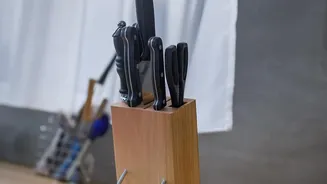
The best way to deal with blade damage is to prevent it in the first place. The rules are simple but non-negotiable for a long-lasting knife. First, always wash your knives by hand with mild soap and warm water—never in the dishwasher, where high heat and harsh detergents are a recipe for corrosion. Dry it completely and immediately with a towel. Second, use proper cutting surfaces, like wood or plastic boards. Third, store your knives safely. A magnetic strip or a knife block is ideal as it prevents blades from knocking against each other, which is what happens when they are tossed loosely in a drawer.
First Aid for Your Knife
For minor issues, you can often play the role of knife medic. Light surface rust can typically be removed with a gentle abrasive. A paste made from baking soda and water, applied and rubbed with a soft cloth, is often effective. If your knife's edge is rolled, a few passes on a honing steel can realign it, instantly restoring its cutting ability. It’s important to understand that honing realigns the edge, while sharpening actually grinds away metal to create a new one. For tiny chips, a coarse whetstone can be used to grind the edge down until the chip disappears, though this requires some practice.
When to Call a Professional
While DIY maintenance is crucial, some jobs are best left to the experts. If your knife has significant rust or deep pitting, deep chips in the blade, a severe bend, or a broken tip, a professional sharpening service is your best bet. They have the specialized grinding equipment to reshape the blade, fix the tip, and establish a new, perfect edge without removing more metal than necessary. For general use, getting your knives professionally sharpened every 6 to 12 months is a good rule of thumb to keep them in peak condition, ensuring they are not only effective but also safer to use.