



What Are The Rings Really Made Of?
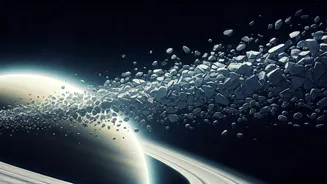
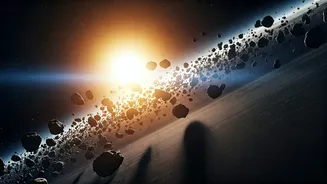
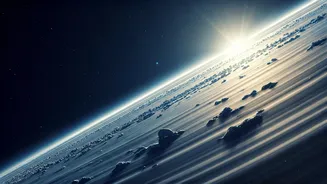
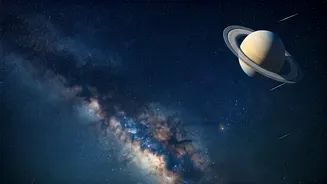
From a distance, Saturn’s rings look like a smooth, continuous band of light. Up close, however, the view is entirely different. They are not solid objects at all. Instead, they are composed of billions, perhaps trillions, of individual particles of ice
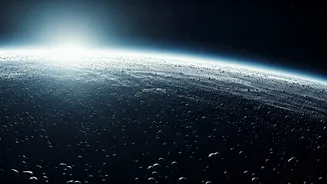
and rock. The vast majority of this material—about 99.9%—is almost pure water ice, with trace amounts of rock and dust that give the rings their subtle colours. The size of these particles varies tremendously. Some are as small as a grain of sugar, while others are the size of a car or even a house. A few are colossal, measuring up to a kilometre across, qualifying them as mini-moonlets. This incredible collection of icy debris orbits Saturn at extremely high speeds, creating the illusion of a solid structure from millions of kilometres away.
A Cosmic Snowstorm In Motion
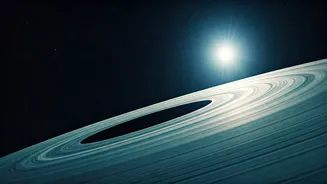
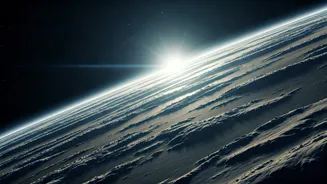
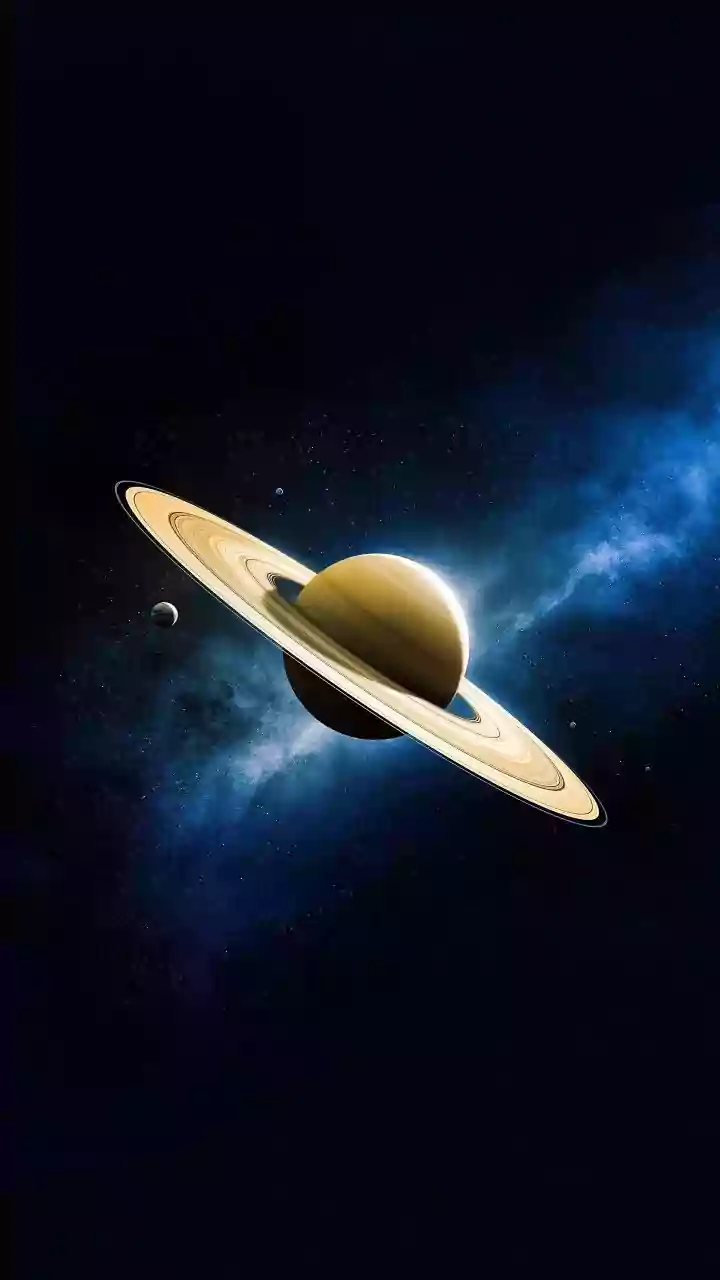
The phrase “moving ice debris fields” perfectly captures the essence of the rings. Each particle is essentially a tiny moon in its own orbit around Saturn. Particles in the inner rings travel faster than those in the outer rings, following the basic laws of orbital mechanics. This constant motion leads to a dynamic, ever-changing environment. Collisions are frequent, breaking larger particles apart or causing smaller ones to clump together. Despite their immense width—stretching up to 282,000 kilometres—the main rings are astonishingly thin. For most of their expanse, they are only about 10 metres thick. This extreme thinness is like a sheet of paper the size of a city. The system is organised into several major rings, lettered in order of their discovery, with gaps and divisions created by the gravitational pull of Saturn’s many moons. The most famous is the Cassini Division, a large gap separating the A and B rings.
Where Did All This Ice Come From?
The origin of the rings has been a long-standing mystery, but scientists now have a leading theory. It’s widely believed that the rings are the remnants of a celestial body—or several—that strayed too close to Saturn and was torn apart by its immense gravity. This could have been a large, icy moon, a comet, or a combination of objects. When a smaller body gets too close to a massive one, it crosses the 'Roche limit,' the point at which the planet's tidal forces are stronger than the body’s own gravity holding it together. The intense gravitational pull would have shredded the unfortunate moon or comet into countless pieces, which then spread out into a disk and settled into the equatorial plane, forming the spectacular ring system we see today.
A Surprisingly Young Spectacle
For a long time, astronomers assumed the rings were as old as Saturn itself, forming 4.5 billion years ago. However, data from NASA’s Cassini spacecraft, which studied Saturn for 13 years, has completely changed this view. The rings are pristine and bright; if they were ancient, they would have been darkened over billions of years by accumulating cosmic dust. Their relative cleanliness suggests they are much younger. Current estimates place the age of the rings at a mere 10 million to 100 million years old. This means they likely formed when dinosaurs still roamed the Earth, a blink of an eye in cosmic terms. Far from being a permanent feature, Saturn’s rings are a relatively recent and possibly temporary addition to the solar system.
A Disappearing Cosmic Wonder
Perhaps the most startling discovery is that Saturn's rings are disappearing. The same gravitational and magnetic forces that shape the rings are also slowly destroying them. Icy particles are being pulled from the rings and are 'raining' down onto the planet's upper atmosphere. This phenomenon, dubbed 'ring rain,' is draining the rings of material at an astonishing rate. Scientists estimate that the rings are losing tonnes of material every second. At this rate, the entire ring system could be gone in as little as 100 million years, and at most 300 million years. In a cosmic sense, we are living in a privileged time, able to witness Saturn in its full glory. Future inhabitants of the solar system may one day look up at a Saturn that is just a plain, ringless planet.