


A Glimpse Across the Void
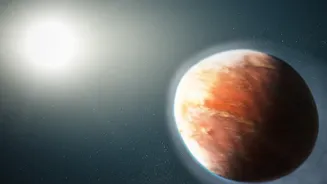
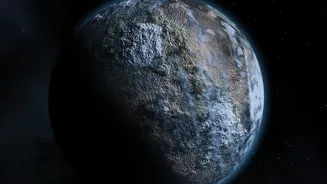
The breakthrough observation focused on WASP-96 b, a gas giant located roughly 1,150 light-years away. While not a candidate for life itself, this 'hot, puffy' planet served as a perfect test subject. It has less than half the mass of Jupiter but is significantly
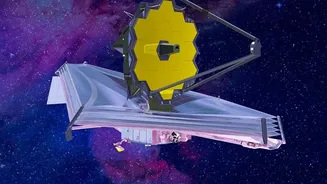
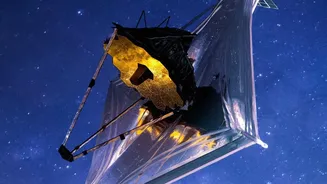
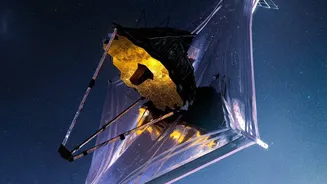
larger in diameter, and it orbits extremely close to its star, completing a full circuit in just 3.5 Earth-days. These characteristics make its atmosphere an ideal target for study. The James Webb Space Telescope (JWST) has now provided the most detailed analysis of an exoplanet’s atmosphere to date, unambiguously confirming the presence of water, along with evidence for clouds and haze—details that were previously out of reach for telescopes like Hubble.
Reading Light from 1,150 Light-Years Away
So, how does a telescope see the air on a planet over a thousand light-years from Earth? The technique is called transmission spectroscopy. As WASP-96 b passed in front of its host star, the JWST’s sensitive instruments analysed the starlight that filtered through the planet's atmosphere. Every chemical element and compound absorbs light at very specific wavelengths, creating a unique barcode or 'fingerprint'. For 6.4 hours, Webb’s Near-Infrared Imager and Slitless Spectrograph (NIRISS) measured this light. The resulting data showed a clear and distinct dip in brightness at the exact wavelengths associated with water molecules, providing an undeniable signature. This level of detail, especially in infrared light, represents a monumental leap forward from what was previously possible.
The Building Block of Life
Finding water is always a thrilling moment in astronomy. Here on Earth, water is essential for every form of life we know. While WASP-96 b is a scorching gas giant with temperatures over 500°C, making it entirely inhospitable, this discovery is not about finding life on this specific world. Instead, it’s a powerful proof of concept. It demonstrates that the JWST can successfully detect the fundamental building blocks for life in the atmospheres of distant planets. This capability is the critical first step on the long road to analysing smaller, rocky, and potentially more Earth-like planets. By perfecting these techniques on larger planets, scientists are preparing for the moment they can turn Webb’s gaze toward a world that might have the right conditions for life to arise.
A New Era for Habitable Worlds
This breakthrough isn't just a single discovery; it marks the beginning of a new chapter in exoplanet science. Before JWST, characterising the atmospheres of rocky planets was nearly impossible. The Hubble Space Telescope first detected water on an exoplanet in 2013, but Webb's power and precision are a game-changer, revealing finer details and a broader range of chemical fingerprints. Scientists are now moving from simply detecting planets to truly understanding what they are made of. The mission is already expanding to survey other worlds, including rocky planets in the 'habitable zone' of their stars, where liquid water could potentially exist on the surface. Each observation refines our understanding of planetary formation and the sheer diversity of worlds that exist in our galaxy.