


A Cosmic Data Deluge
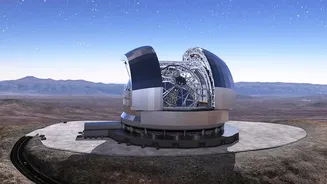
For centuries, astronomy involved pointing a telescope at the sky and carefully documenting what was seen. Today, modern observatories are digital behemoths. The Vera C. Rubin Observatory in Chile, for instance, is set to generate around 20 terabytes
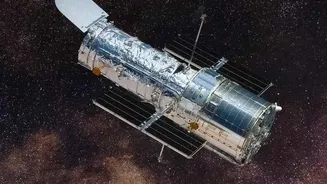
of data every single night. To put that in perspective, it would take thousands of high-definition TVs just to view one of its full-resolution images. Over its ten-year survey, it will create a data archive about 50,000 times the size of the entire US Library of Congress. This torrent of information from telescopes like Rubin, Hubble, and the James Webb Space Telescope presents a monumental challenge: there is simply too much data for human eyes to ever review manually.
Teaching AI to Spot the 'Weird'
This is where artificial intelligence, specifically a type of AI called a neural network, comes into play. Instead of telling the AI what to look for, scientists are training it to recognise 'normal'. By feeding an AI millions of images of known objects like stars and typical galaxies, it learns to identify the standard patterns of the cosmos. The real magic happens when the AI is then unleashed on new or archival data. Its job is not to name what it sees, but to flag anything that deviates from the norm—anything that looks anomalous. This approach is called anomaly detection, and it's perfect for finding the cosmic needles in a universe-sized haystack.
Early Successes and Strange Discoveries
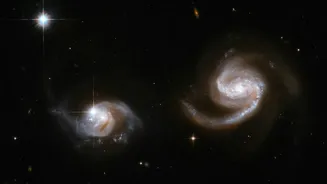
This isn't just a theoretical concept; it's already yielding spectacular results. In one recent project, researchers used an AI tool named AnomalyMatch to sift through 35 years of data from the Hubble Space Telescope. In just two and a half days, the AI analysed nearly 100 million image cutouts and flagged over 1,300 anomalies. Of those, more than 800 were objects that had never been documented before. These weren't just blurry smudges; they included rare phenomena like colliding galaxies, new gravitational lenses, and bizarre 'jellyfish' galaxies with trailing tentacles of gas and stars. Perhaps most excitingly, several dozen of the objects defied any existing classification, hinting at entirely new astrophysical phenomena.
Beyond Anomalies: A Versatile Cosmic Assistant
Finding new object types is just one of AI's many roles. Other AI systems are being trained for more specific tasks. An AI called RAVEN recently confirmed over 100 new exoplanets, including 31 worlds previously hidden in data from NASA's TESS mission. It does this by learning to distinguish the tell-tale dip in starlight from a planet passing in front of its star from false signals caused by other cosmic events. Other AIs are being used to sharpen images from ground-based telescopes to make them look as crisp as if they were taken from space, classify known galaxies with over 98% accuracy, and even help predict where to point telescopes to catch fleeting events like exploding stars, known as supernovae.
The Human-AI Partnership
The goal of using AI in astronomy isn't to replace human scientists. Instead, it acts as an incredibly powerful filter. The AI's role is to perform the exhaustive, time-consuming task of the initial search, flagging candidates that are worth a closer look. It is then up to human astronomers to take those flagged anomalies, validate them, and apply scientific context and interpretation to understand what they truly are. This partnership allows scientists to spend less time sifting through noise and more time focused on analysis and discovery. The AI finds the interesting candidates, but the human experts are the ones who ultimately make sense of the discovery, turning a statistical anomaly into a new piece of cosmic knowledge.