




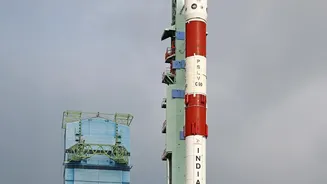
The New Space Race Is Private
The Indian space landscape has transformed dramatically. Landmark policy reforms in 2020, spearheaded by the creation of the Indian National Space Promotion and Authorisation Centre (IN-SPACe), officially opened the final frontier to private enterprise.
This move has catalysed explosive growth, with the number of space startups soaring from a handful to nearly 400. India's space economy, currently valued at around $8-9 billion, is projected to reach as high as $44 billion by 2033. This isn't just about encouraging businesses; it's about creating a parallel ecosystem where innovation can thrive, unburdening ISRO to focus on deep-space exploration and R&D while private players build the commercial infrastructure.
Building the Constellations: Satellite Tech
One of the most vibrant areas of the private space boom is satellite manufacturing and operations. Companies are no longer just supplying components to ISRO; they are designing, building, and flying their own constellations. Hyderabad-based Dhruva Space, for instance, offers full-stack solutions, from satellite design to launch and ground segment support. Bengaluru's Pixxel is making waves globally with its plans for a constellation of high-resolution hyperspectral imaging satellites. This sector is hungry for talent in aerospace, mechanical, and electrical engineering, especially for roles in assembly, integration, and testing (AIT), as well as embedded systems and quality assurance.
The Downstream Goldmine: Data and Analytics
Launching hardware into space is only half the story. The real value for many businesses lies in the data those satellites collect. This “downstream” sector is a goldmine for careers. Satellite data is being used to revolutionise agriculture, monitor climate change, underwrite insurance, and plan urban infrastructure. Companies like SatSure specialise in leveraging satellite imagery for agriculture and climate analytics. This has created a massive demand for professionals who can make sense of this data: data scientists, geospatial analysts with GIS skills, and machine learning engineers who can build predictive models. If you have a background in software and data, the space industry now has a firm place for you.
The Launch Pad: Rockets and Propulsion
While ISRO remains the undisputed leader in launch capabilities, private launch vehicle startups are closing the gap with remarkable speed. Hyderabad's Skyroot Aerospace became the first Indian private company to successfully launch a rocket, the Vikram-S. Chennai-based Agnikul Cosmos is pioneering with its 3D-printed, semi-cryogenic engine and has established India's first private launchpad. These companies are aggressively hiring for core engineering roles in propulsion, avionics, structural design, and materials science. They offer a fast-paced environment where engineers can work on a rocket from design to launch in a fraction of the time it might take in a larger organisation.
Ground Control: Mission Support and Beyond
A satellite or rocket is useless without the vast network of ground systems to control and communicate with it. This creates a wide array of career opportunities in the ground segment. Roles include spacecraft controllers, network engineers, and mission operations strategists who plan and execute space missions. Furthermore, as space becomes a more contested domain, the need for cybersecurity professionals to protect space assets from interference is growing rapidly. The ecosystem also requires professionals in non-technical roles, including business development, program management, finance, and space law, to help these companies grow and navigate the complex regulatory landscape.
The Essential Skills for Liftoff
To break into India's private space sector, a blend of foundational and modern skills is key. A strong base in a core engineering discipline (aerospace, mechanical, electrical, computer science) is often the starting point. Proficiency in software and programming languages like Python and C++ is increasingly essential across all domains, from flight software to data analysis. Expertise in design and analysis tools like CATIA, ANSYS, and NASTRAN is highly sought after in hardware roles. For data-centric jobs, experience with GIS software and cloud computing platforms like AWS is crucial. Beyond technical skills, these fast-paced startups value adaptability, a hands-on approach to problem-solving, and a passion for building the future.