





A Nursery for New Worlds
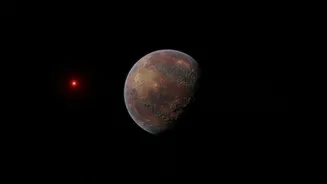
Astronomers have trained the powerful gaze of the James Webb Space Telescope (JWST) on a young star system called PDS 70, located about 370 light-years away. This system is a fascinating cosmic laboratory; it’s a star that is still surrounded by a massive
disc of gas and dust known as a protoplanetary disc. This disc is the raw material from which planets are built. The PDS 70 system is already known to host at least two gas-giant planets, similar to Jupiter, which have carved a huge gap in this disc as they orbit the star. But the latest discovery, made using Webb’s Mid-Infrared Instrument (MIRI), has generated immense excitement. For the first time, scientists have detected a significant amount of water vapour in the inner part of the disc, the region where rocky, terrestrial planets would be expected to assemble.
The Significance of Steam
On Earth, water is the foundation of life as we know it. A major question in planetary science is how our world became so water-rich. Did it form with water from the very beginning, or was water delivered later by icy comets and asteroids? The discovery at PDS 70 provides a compelling piece of evidence for the first scenario. By finding water vapour in the hot, inner region of the disc—at a distance from its star similar to Earth's distance from the Sun—it suggests that rocky planets forming there would have access to a local reservoir of water from day one. This dramatically increases the odds that newly formed planets could be habitable. According to Giulia Perotti, the lead author of the study published in the journal Nature, this is the first time water has been seen so close to the star in a system where planets are actively being built.
A Technological Triumph
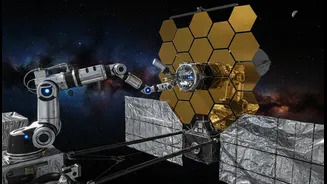
This kind of observation was simply impossible before the launch of the JWST. The ten-billion-dollar observatory, a joint project of NASA, the European Space Agency, and the Canadian Space Agency, is an engineering marvel designed to see the universe in infrared light. Its MIRI instrument can peer through the dust and gas that obscures the view of other telescopes, allowing it to analyze the chemical composition of these distant planetary nurseries. The detection of water vapour in PDS 70's inner disk is a prime example of the telescope delivering on its promise, providing a return on investment in the form of groundbreaking scientific knowledge that reshapes our understanding of the cosmos.
A Surprising and Puzzling Find
The discovery was also surprising. At an estimated 5.4 million years old, PDS 70 is considered relatively mature for a star with a planet-forming disc. Scientists previously thought that the intense radiation from a star would have blown away most of the water from the inner disk by this stage, leading to the formation of dry, rocky worlds. The presence of water vapour raises new questions. How did the water get there? One theory is that icy particles from the cold outer regions of the disc are drifting inwards, releasing their water as vapour when they cross a boundary called the "snowline". Another puzzle is how the water survives so close to the star, where ultraviolet radiation should break it apart. Scientists speculate that the surrounding dust and even other water molecules may be acting as a protective shield.
The Next Chapter in Planetary Science
While astronomers have not yet detected any planets forming within the inner disc of PDS 70, they now know that the essential ingredients are there: silicates (the building blocks of rock) and water. This discovery doesn't just provide a clue to our own solar system's past; it helps scientists refine their models of planet formation across the galaxy. It suggests that many rocky exoplanets could be born with water, a key factor in the search for life beyond Earth. Researchers will continue to study the PDS 70 system with other Webb instruments, hoping to gain an even clearer picture of how this future solar system is taking shape.