


The Classic Cosmic Villain
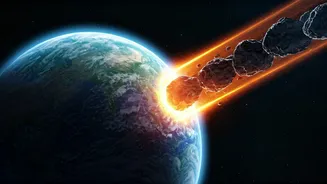
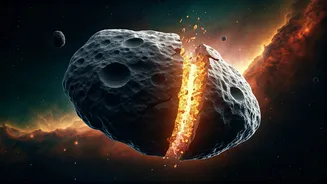
For decades, asteroids have been cast as the ultimate antagonists in Earth's story. The most famous example, of course, is the Chicxulub impactor—a colossal space rock, roughly 10 kilometres wide, that struck the Yucatán Peninsula 66 million years ago.
The impact triggered a global cataclysm, leading to the mass extinction that wiped out the dinosaurs and about 75% of all species on the planet. This event cemented the asteroid's reputation as a 'planet killer.' It’s a powerful and terrifying narrative, reinforced by blockbuster movies and constant headlines about 'potentially hazardous asteroids.' While the threat is real and something space agencies monitor closely, this focus on destruction overshadows a far more profound and creative role these celestial travellers played in our planet's history.
Earth's Primordial Water Delivery
Imagine a young Earth, more than four billion years ago. It was a hot, volcanic, and largely dry world. So where did the vast oceans that cover 70% of our planet's surface come from? A leading theory points directly to the sky. During a period known as the Late Heavy Bombardment, the inner solar system was a chaotic shooting gallery. Countless asteroids and comets, rich in ice, slammed into our young planet. Over millions of years, these impacts acted as a planetary-scale water delivery service. Each collision deposited its frozen payload, gradually filling the basins that would become our oceans. Without this constant pelting from space, Earth might have remained a barren rock. These ancient impacts didn't just scar the planet; they hydrated it, creating the single most important ingredient for life as we know it.
More Than Just Water
While delivering water is a game-changer, the story gets even more incredible. Asteroids weren't just carrying ice; they were also ferrying complex organic molecules. These are the carbon-based compounds that form the fundamental building blocks of life, including amino acids (which create proteins) and nucleobases (which form DNA and RNA). For years, scientists have studied meteorites—fragments of asteroids that have survived the journey through our atmosphere and landed on Earth. Famous examples like the Murchison meteorite, which fell in Australia in 1969, were found to be packed with over 100 different amino acids. This discovery suggests that the raw materials for life weren't necessarily cooked up on Earth, but were instead imported from space. The asteroids that once bombarded our planet may have seeded it with the very chemistry needed to spark biology.
Evidence Straight from the Source
The theory of asteroids as life-bringers has received a massive boost from recent space missions. Instead of just waiting for meteorites to fall, we've gone directly to the source. Japan's Hayabusa2 mission successfully collected samples from the asteroid Ryugu, and NASA's OSIRIS-REx mission did the same at the asteroid Bennu. The analysis of these pristine samples, uncontaminated by Earth's environment, has been revelatory. The material from Ryugu was found to contain uracil—one of the four bases in RNA—as well as nicotinic acid, or vitamin B3, which is crucial for metabolism. These findings provide the strongest evidence yet that the building blocks of life are abundant on carbon-rich asteroids. It confirms that the early Earth was showered with a prebiotic chemical toolkit, delivered courtesy of the solar system's wandering rocks.
Architects of a Habitable World
This evolving understanding forces us to see asteroids in a new light. They are not simply agents of chaos and extinction. They are agents of creation and transformation. Their legacy is dual: they are capable of taking life away on a massive scale, but they also appear to have been instrumental in providing the materials for life to begin. They delivered the water for the primordial soup and then sprinkled in the key ingredients. This reframes our entire cosmic origin story. It suggests that the emergence of life on Earth wasn't a fluke but perhaps an expected outcome, given the right planetary conditions and a steady supply of space-delivered resources. The very same celestial bodies we fear hold the secret to our own existence.